When Paul Knight addressed the National Trust election forum late last year, he encouraged a new approach when considering Aboriginal cultural heritage. As I read his words, I saw that it applied not just to Indigenous Australian cultural heritage but on thinking critically about Australian “cultural heritage” in general.
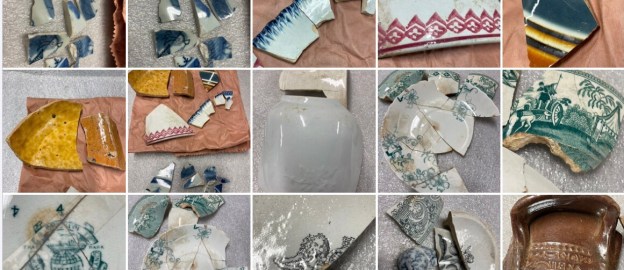
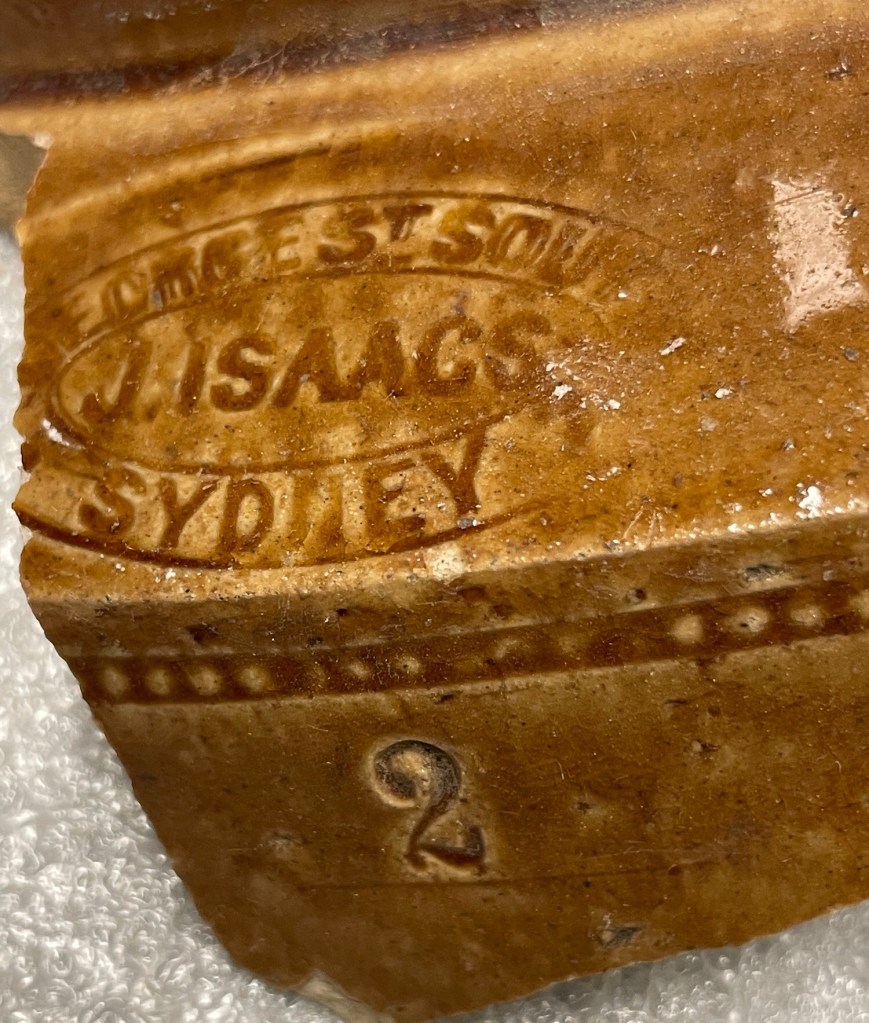
What can archaeology tell us about the past and people who used these items?
Knight states that it isn’t just the buildings and objects that matter but rather “ the stories of place, the stories of people and the relationship that we have with that place”.
There are significant and great losses of cultural heritage from every layer of Australian history – Indigenous, Colonial and Multicultural. When you dissect the outcomes, it is so much more than just a loss of a habitat or a building or an object – it is that every single loss becomes magnified in the context of a much larger jigsaw of place and/or landscape. How does the destruction of heritage buildings or removal of a group of trees change the feel of a street or the city CBD or the suburb that we live in or indeed the landscape that they were once part of? Imagine The Rocks in Sydney CBD being flattened and replaced with high rise buildings. How much harder would it be to tell the stories of early Sydney town without its original streetscape? How wonderful it is to be able to visit the towns of Indigo Shire and Ballarat in Victoria which exhibit intact cultural heritage (houses, gardens, historic buildings) as a backdrop to the stories of Australia during the gold rush times.
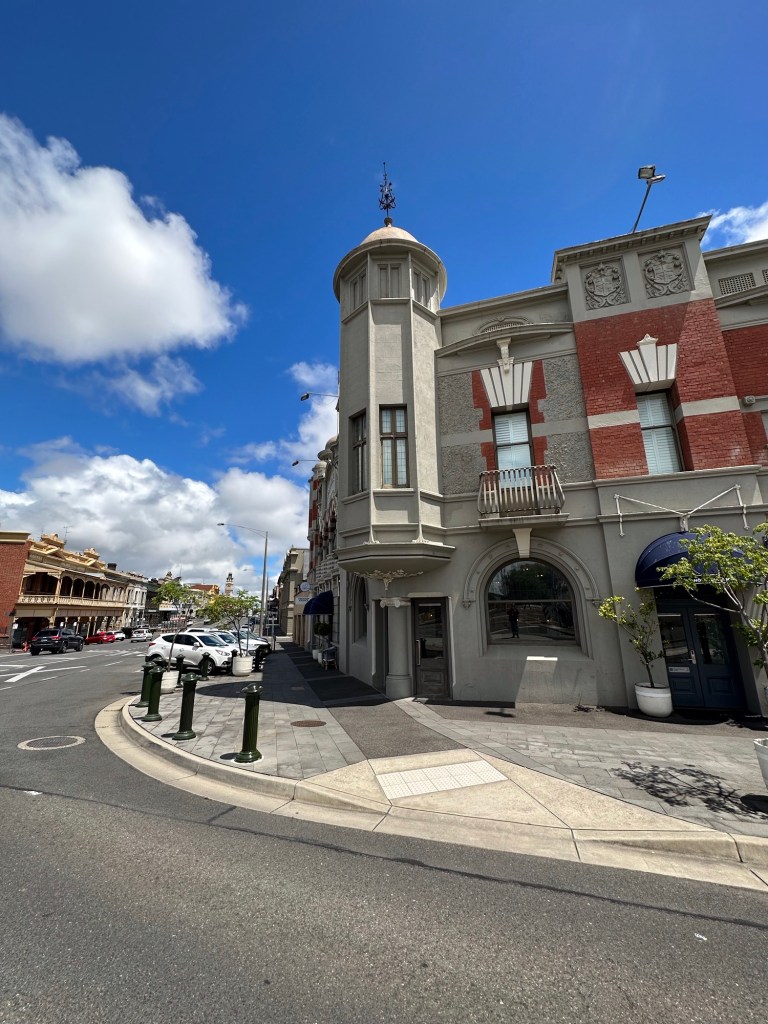
The City of Ballarat, Victoria. Heyday in the 1850s from the rich alluvial gold deposits.
Knight talks about individual sites and their connection to the greater surrounding area and that loss of context and connection impacting upon the total heritage landscape. It’s so true. As we redevelop and clear and subdivide and dig – we permanently change not only the surface area of the landscape (whether forested or built) but the archaeological landscape below the surface. The eventual “cover up” causes irreversible damage and may include the loss of the evidence to tell “tangible” stories attached to the history of that place. Archaeological finds are so critical for research and interpretation of the past lives lived right under our feet.
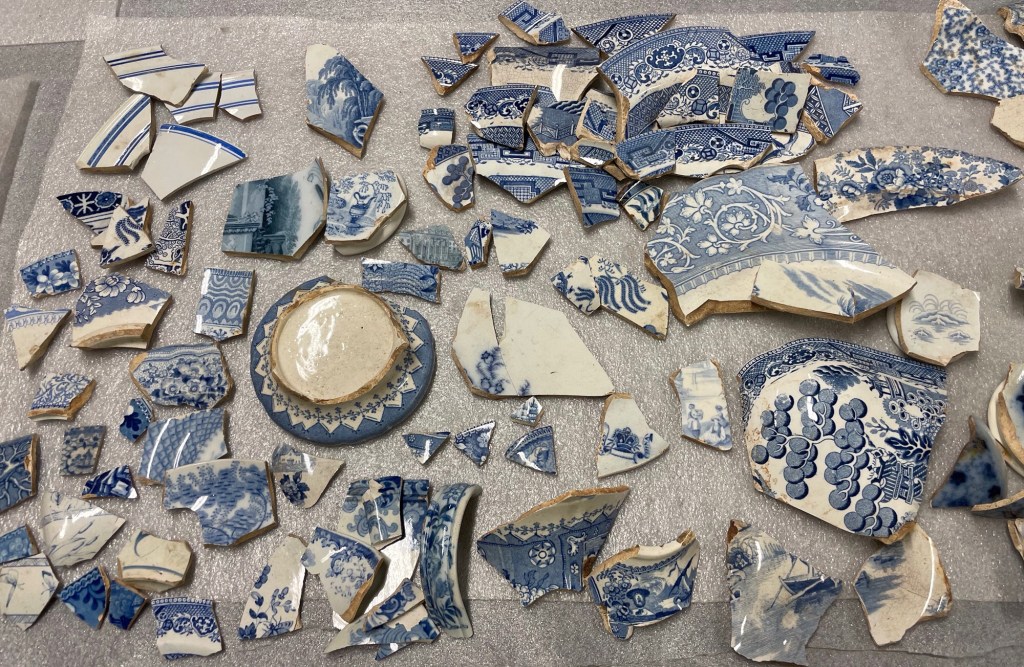
So many patterns and types of blue and white ceramics from a single archaeological find in Parramatta, NSW. What story do they tell?
Indigenous Australians talk of their connection to “country” and being custodians of the land – I really get that. We need to pay attention to this way of seeing Australia – not only being connected to the landscape but to the built environment and other layers of Australian history (“warts and all”). We must all adapt to a different way of thinking – realising that we are all the caretakers of our cultural heritage and are just passing through. For future generations there needs to be stories and a connection to the past. We must ensure that we protect all the layers of cultural heritage and rethink the model of protection for individual sites and objects and assess them as part of the whole heritage landscape rather than case by case examples.
Heritage Legislation is critical in ensuring that Australians are custodians of their own history. We all need clear guidelines about the ways we can protect the past at both state level and a national level and including shipwrecks and our sunken past off the coast.
The State of Victoria has lead the way educating us about the past by building its Victorian Collections Platform – cataloguing and interpreting archaeological and heritage finds. The information is accessible to everyone online. Food for thought?
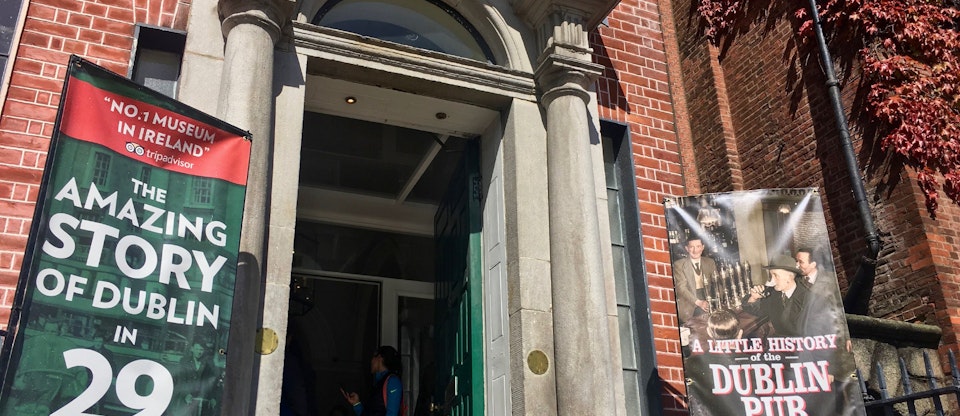
The Little Museum of Dublin. Picture by Lonely Planet
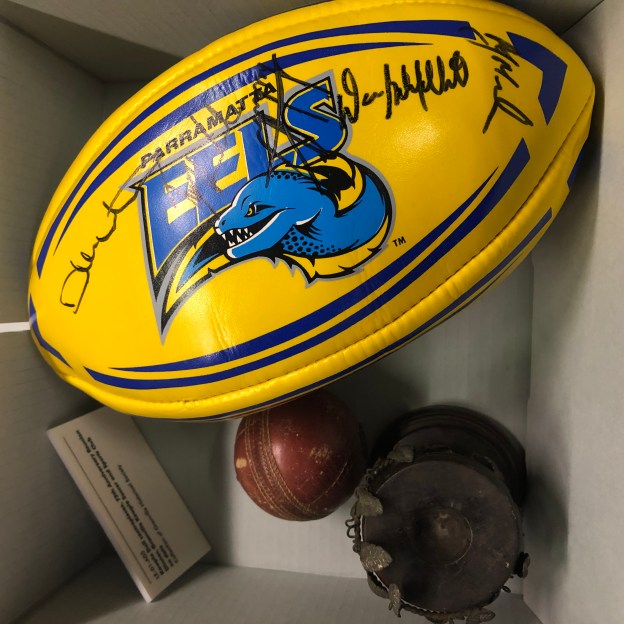
What I know about Parramatta is that it’s not just about stadiums, new high rise development, Parramatta Eels and Western Sydney Wanderers. In my opinion, the City of Parramatta has a rich cultural heritage which could be a more significant tourist attraction and contribute greatly to building the community and economy of Western Sydney.
The City of Parramatta Council has a culturally significant collection of objects and archives dating back to the earliest days of council (1861), and archaeological evidence dating back to much earlier times. Parramatta’s historical layers provide the perfect inspiration for its own unique museum which I’m calling “The Museum of Parramatta”, not to be confused with the new MAAS Museum (which is a completely different concept) coming to Western Sydney in the future.
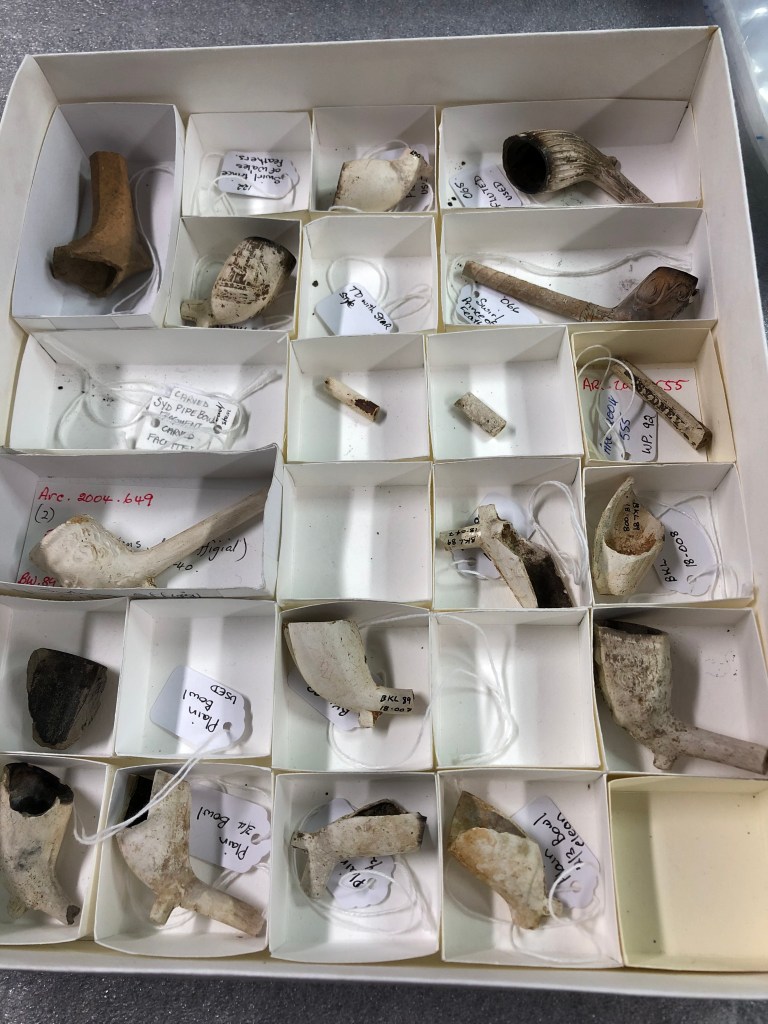
Kaolin Pipe stems and bowls from the collection of the City of Parramatta
In my mind, Australia has three distinct layers of history which make it what it is today. It is too late to undo the colonisation of Australia by the British, but we can look harder at our history, dissect it and present it in new and better informed ways. History is not fixed – it is open to further research and interpretation from primary sources and definitely open to further discussion. I would say that the City of Parramatta is the perfect place to examine and discuss Australian history by exploring further its Indigenous layer, Colonial layer and its waves of migration or the Multicultural layer.
I envisage that The Museum of Parramatta would use 4 spaces to present the Parramatta story – past and present – a story of its First Nations people dating back 40,000+ years, to the arrival of Europeans and the successive waves of migration from 1788 until the present. The museum will also need a functional space for permanent exhibitions, travelling or changing temporary exhibitions and for the public to access Parramatta’s history using onsite digital resources similar to and building upon those available in the existing Parramatta Local Studies Library.
Aboriginal Warriors by Joseph Lycett (1815-1822). National Library of Australia Collection
Space 1. Our First Australians
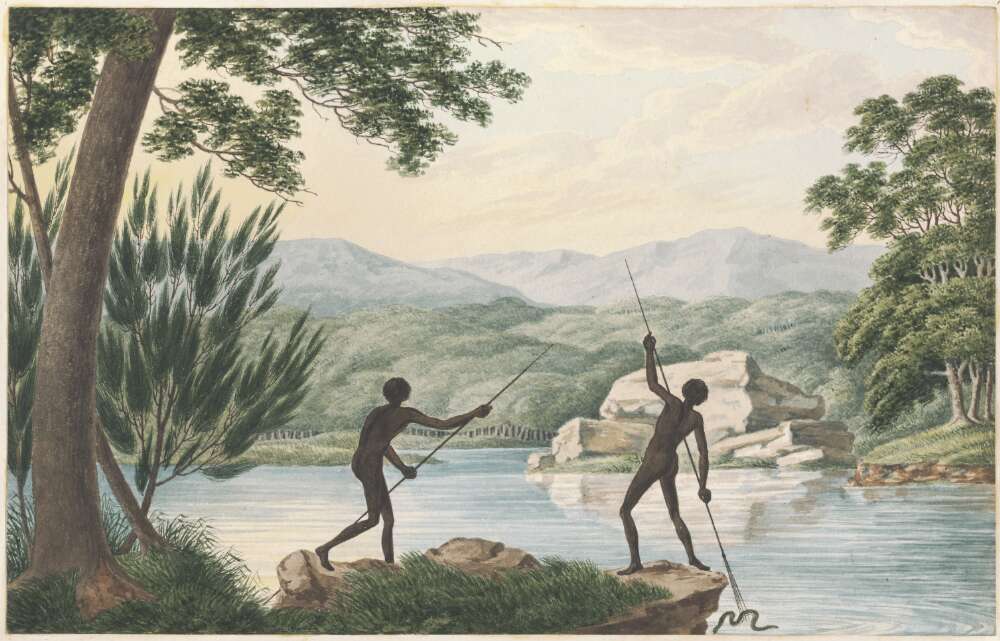
Starting at the beginning, I have imagined that Space 1 would need to be created in consultation with local Indigenous groups. We need to know Australian history from an indigenous perspective – we are all still learning the facts about our past. How did Aboriginal people live in Parramatta? What were their totems? What animals and foods were special to them? What was the impact that Colonial settlement had on the cultural practices on Indigenous groups already living in Parramatta and surrounding areas. The story goes back much further than Colonial settlement in Australia to more than 40,000 years ago. Who were the standout Aboriginal characters – individuals who were important local leaders and who managed to straddle both worlds at that time of first contact? Some of the stories will be hard to hear but they need to be told. Australians must think more critically about the past rather than continuing to look at history from a Eurocentric perspective.
Two Aborigines spearing eels by Joseph Lycett (c1817). National Library of Australia collection.
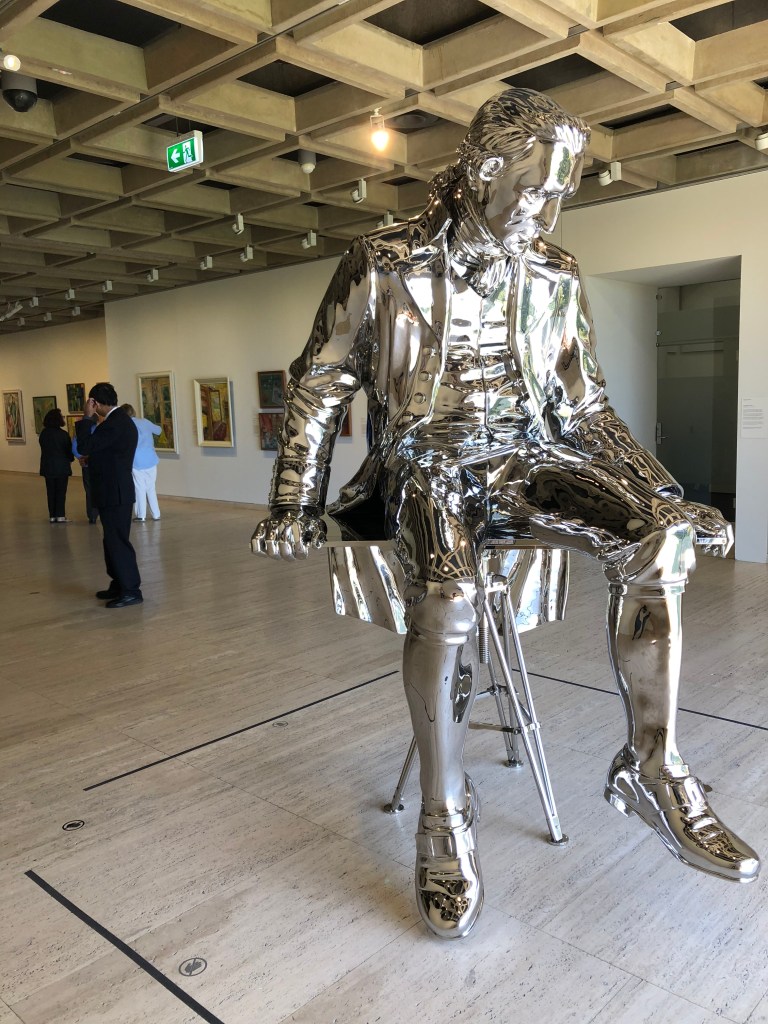
I recently participated in an online FutureLearn Course called Confronting Captain Cook: Memorialisation in Museums and Public Spaces which examines both sides of Captain Cook’s encounters with First Nations People in the Pacific and and how various societies related differently to his legacy. This reinforced my ideas about a need for Space 1 in the Museum of Parramatta.
The English Channel (2015) by Michael Parekowhai. Captain Cook reflecting on his legacy in a contemporary world. How do Pacific nations view him now , 250 years after their first encounter?
Space 2. The Colonial Years and birth of Parramatta Council
This area would be used to unpack Parramatta’s Colonial layer. There is plenty of archaeological and archival evidence to support learning about the built environment, but sadly there has been a significant loss of the “intact’ heritage buildings from Colonial times as a result of neglect, “progress” and development. Much of this destruction occurred before the Heritage Act was introduced in 1977. There are a number of significant sites in Parramatta which could be cross promoted through The Museum of Parramatta such as Old Government House and Experiment Farm Cottage (National Trust of Australia), Elizabeth Farm (Sydney Living Museums), Hambledon Cottage, Parramatta Female Factory Precinct, Lancer Barracks ………and the list goes on (see more detail at the end of this post).
Space 2 could utilise the objects from the City of Parramatta’s collection of archaeological and culturally significant material as well as its Archives. It will be a great space to tell the stories of Parramatta’s early history using the collection as tangible evidence of the past.
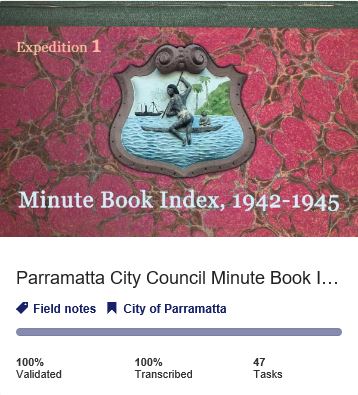
One of the many Expeditions for the City of Parramatta DigiVol project
The current City of Parramatta DigiVol project has a team of 120 volunteers transcribing the Parramatta Council Minutes from 1862-1945. The minutes tell of the everyday issues facing a new rapidly growing town. When the minutes become searchable primary source, it will bring the Councillors and the people of Parramatta’s past to life. TROVE is also a wonderful resource for reading news from the early days of Parramatta via the old newspapers in digitised form.
The team at Parramatta Heritage and Visitor Information Centre has researched so much about the city’s past which is available via their blog posts. Another significant body of work was researching all the Parramattans involved in the Great War . The team has produced a range of publications on the subject and also a travelling touchtable resource for the public to access.
Space 3. Waves of Migration
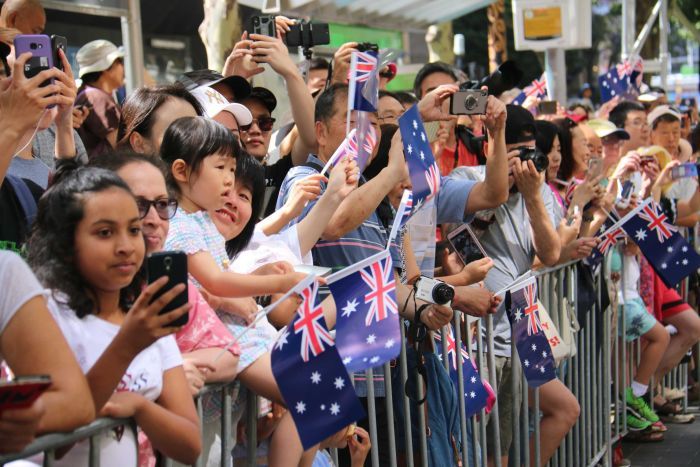
Successive waves of migration have shaped the culture and identity of Parramatta. It is home to many people with different pasts, and it is important to recognise that there are connections between the city of Parramatta and the new migrant communities that now call Parramatta home. We know that Chinese people migrated to NSW in the earliest days of the colony. Indian and Lebanese people also came very early on when the colony formed and have participated in the growth and cultural heritage of Parramatta and NSW.
Australia Day at Parramatta
The ‘Waves of People’ report was produced by Western Sydney University for the City of Parramatta. The research recounts the history of Parramatta’s inhabitants – from the generations of Darug families living along the Parramatta River and Australia’s first inland European settlement, to the waves of migrants and refugees from all over the world who made a home here.
“It is the accumulation of stories and experiences inscribed in built form that gives a place its distinct identity. Such stories are not only for the culturally sensitive: they drive real-estate investment too. When a city is rebuilt from scratch, we risk losing these stories and connections.” (The Conversation : Reimagining Parramatta)
As well as connecting to the past, Parramatta’s calendar is filled with festivals such as – Parramasala, Diwali, Lunar New Year, ParraLanes and Winterfest to name just a few. These festivals build on Parramatta’s Cultural Heritage and help to bring the community together in the present.
Celebrating Holi at Parramatta
Space 4. Changing exhibitions
This space is essential for presenting temporary exhibitions or travelling exhibitions from other cultural institutions to engage with local and wider audiences of The Museum of Parramatta. The area would provide a safe meeting place for discussion on contentious issues, talks and events. It needs to have banks of computers to be available for research and discovery. The area would be well supported by the existing Local Studies Library, allowing visitors to research in depth information about Parramatta and their connections to the area. It should also host a searchable map of Parramatta to showcase all the amazing historic buildings, house museums and small volunteer run museums in the local area (some mentioned previously and also see the links below).
Final Words
Maybe I’m dreaming, but I believe that Parramatta is worthy of its own purpose built museum (or a museum reimagined in an existing heritage space e.g. Fleet Street Precinct, Old Kings School, Willow Grove) to showcase the history of this city. Parramatta deserves The Museum of Parramatta as well as a satellite of the Museum of Applied Arts and Science (Powerhouse Museum – an existing cultural institution being transplanted in Parramatta). It deserves a well thought out museum of its own to take a more critical look at Australian History from a Parramatta perspective.
Want to think more critically about Parramatta’ history and cultural heritage? Explore the links below.
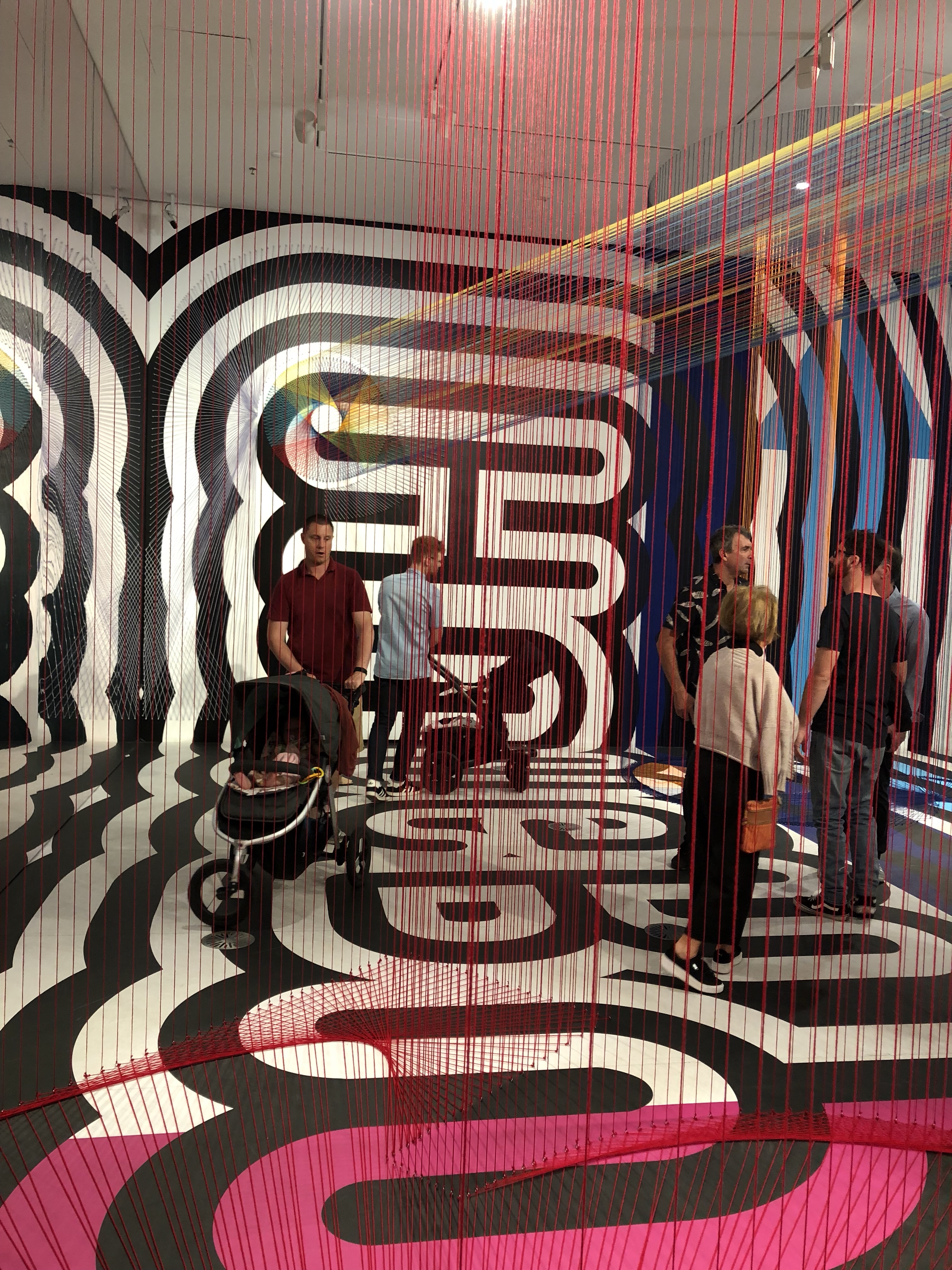
Pae White’s colourful installation drawing in all ages
The National Gallery of Victoria (NGV) is Australia’s oldest and possibly most well loved museum of art, founded in 1861. Its mission statement – “To illuminate life by collecting, preserving and presenting great art” and perhaps the unwritten mission of “giving it to the people”.
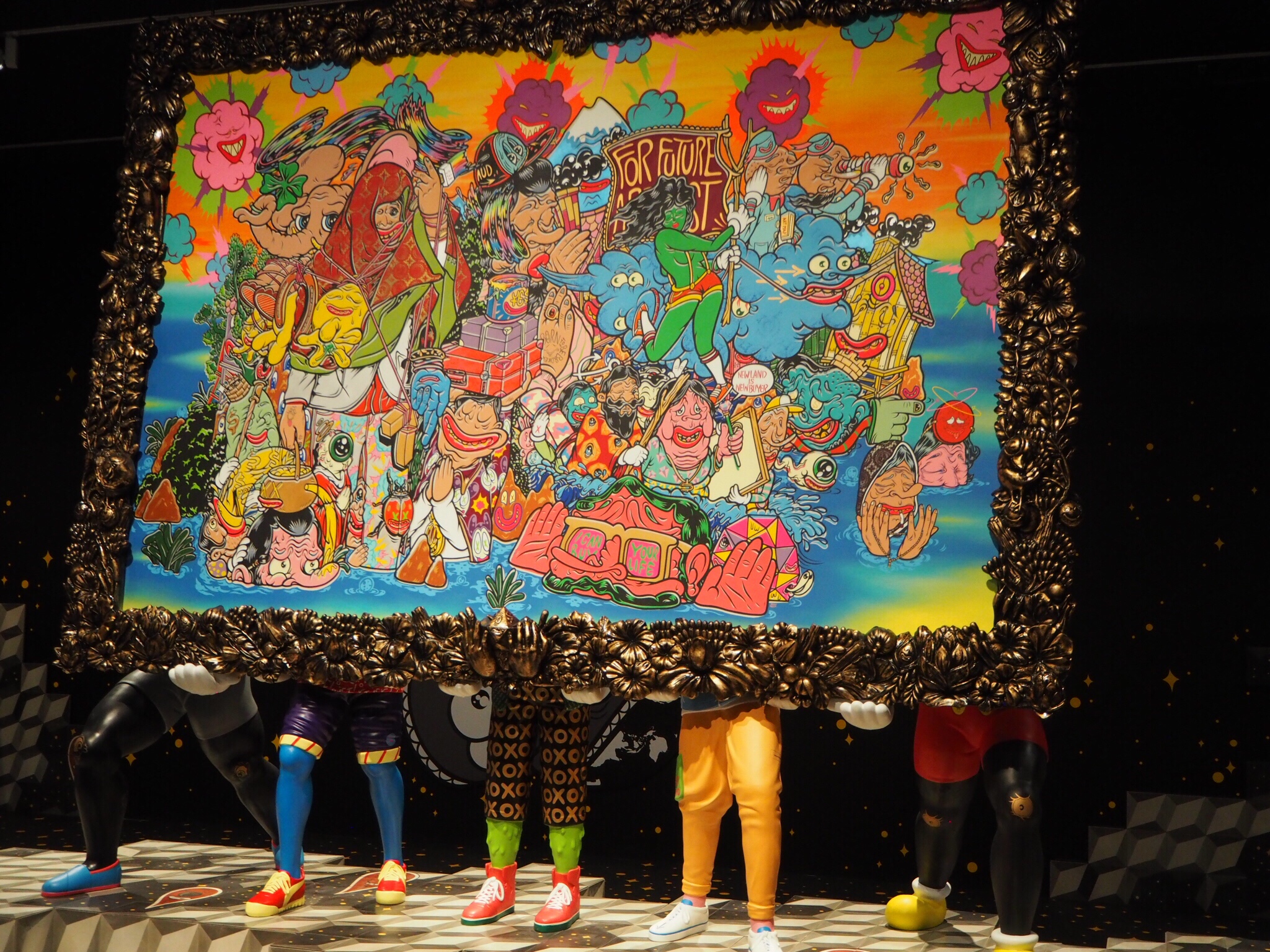
NGV Triennial 15 December 2017-15 April 2018
In 2016 the NGV was the 19th most popular art gallery in the world with more than 2.6 million visitors across its two campuses. The ranking places the gallery in the company of Paris’s Musee d’Orsay and New York’s Museum of Modern Art.
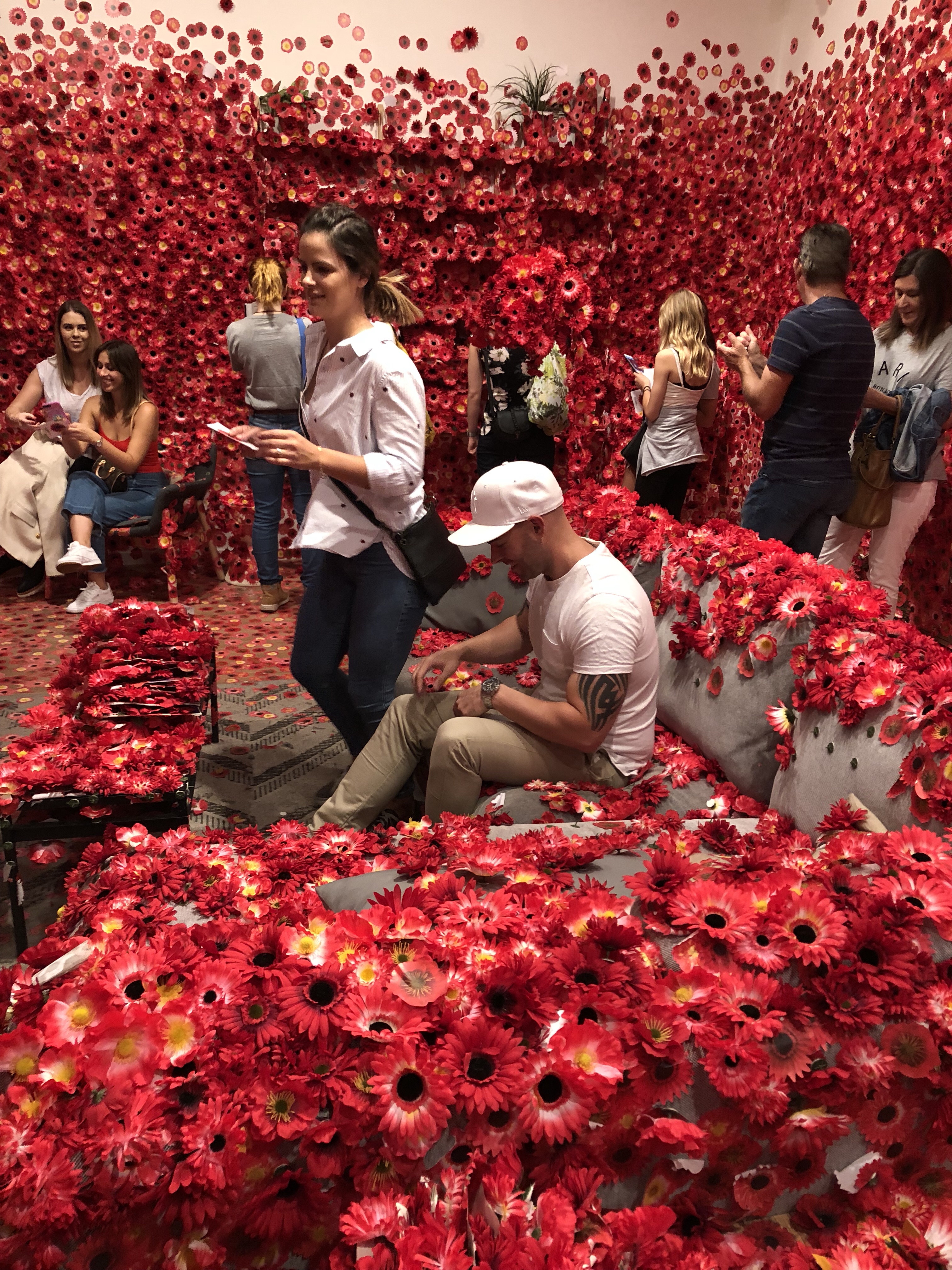
Yayoi Kusama’s Obliteration Rooms are always popular with visitors
The NGV held forty-nine exhibitions during 2016-17, including major retrospectives of international and Australian artists and designers, as well as focused displays of works in the NGV collection. The quality and variety of audience engagement initiatives presented in support of these exhibitions was extensive. They offered guided tours, audio tours, mobile phone apps, talks, lecture series and workshops as well as social events – such as the Friday Night events (aimed at capturing more of the younger audiences after work), the Summer Sundays music series and the NGV Kids Summer festival and supporting Kids spaces for some of the major exhibitions. For example – as part of the exhibition Andy Warhol / Ai Weiwei (2015-2016), NGV Kids presented Studio Cats, a large-scale installation especially for children and families to draw upon creative connections between the two artists and their mutual love of cats.
The Gallery aims to present programmes that engage visitors in meaningful cultural experiences and to keep them coming back.
According to their audience research data, The National Gallery of Victoria enjoys one of the highest community participation rates in the world. 70% of their visitors are local from Melbourne and regional Victoria unlike many other international art museums where the majority of visitors are incoming tourists. This also indicates that the locals keep coming back which is what every cultural institution needs to strive for. This is what Nina Simon talks about most recently in The Art of Relevance but also in The Participatory Museum and her Museum 2.0 Blog.
For any Cultural Institution, the collection remains fundamental to the audience engagement and education strategy. The thoughtful curation and presentation of historical and contemporary collections is a key museum management strategy for continuing and ongoing audience engagement. Colleen Dilenschneider regularly writes about this in her Know Your Own Bone Blog (most recently in Special Exhibits vs. Permanent Collections (DATA) and previously in Death by Curation).The NGV strategy is to ensure that its collection is accessible to the widest possible audience who may be unable to visit the museum through the ongoing work of the NGV Digitisation Project which is still progressing.
I have to disclose that I am already a big fan of the NGV and the way that they design their spaces. I visit the NGV each time that I am in Melbourne, so over many years have enjoyed both Summer and Winter exhibitions as well as taking time to learn about the permanent collection shown across both campuses (St Kilda Road and the Ian Potter Centre in Federation Square). On my recent visit I took in the inaugural Triennial at the National Gallery Victoria which on the surface (without actual audience data analysis) appears to be a great success. What I enjoyed most about this free experience was seeing the diversity of visitors attending the exhibition and the way that the work of 100 contemporary artists, architects and designers from 32 countries was juxtaposed against the existing works from the collection – which was great exposure.
Audience engagement with the art at NGV Triennial
I think that there is currently a cultural revival happening worldwide despite Government funding cuts trying to choke the Arts into submission. Creativity and cultural heritage feed the soul when so much about modern life seems to do the opposite. Now is a better time than ever for cultural institutions to offer their prospective audiences something new and different, to re-energise and maybe even reinterpret their collections to be more inclusive, to build community and feed the souls that are weary of modern life and meaningless 24 hour connectedness to media, social media and globalised sameness. Keep leading the way National Gallery of Victoria and hopefully other cultural institutions in Australia will follow or at least just lift their game a notch.
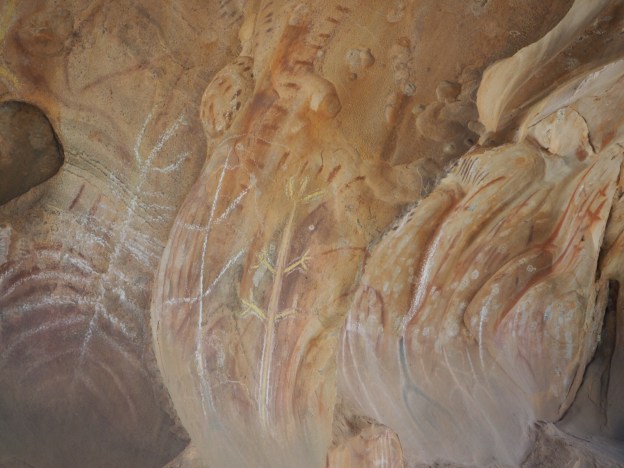
During a trip to the Flinders Ranges in South Australia, I saw fossils that were evidence of the earliest forms of life on Earth and admired incredible Indigenous rock art. Exploring such an ancient landscape, with its natural beauty and deep sense of spirituality, inspires a deeper appreciation for the rich culture of our First Australians.
Xanthorrea – Flinders Ranges
Arkaroo Rock walk – Flinders Ranges
I’m slowly beginning to grasp the deep connection Indigenous Australian people have to the land after spending time in places like the Flinders Ranges and Mungo National Park, and by listening to local Park Rangers as well as interviews like 702 ABC Radio’s Conversations with Richard Vidler. Richard interviewed Lynne Kelly about her book “The Memory Code” in 2017. Lynne has explored traditional Indigenous Australian songlines as a key to memory, revealing layers of information embedded in the Australian landscape. These songlines are passed down through stories, songs, and traditional dance.
The strong unwritten and oral history of Aboriginal Australians is passed down by Elders within the community. So much of this knowledge is key to survival. Knowledge about the landscape, navigation, ancestral totems, food and medicine, trade routes, culture, law and history. Information is shared through stories, traditional dance and song. Kelly speaks about the way that non-written memory systems are coded into the natural and built environment. She believes that this system was not only used in Australia but may have been used by other ancient cultures around the world.
This slideshow requires JavaScript.
Learning how Songlines work has changed my perspective on the harm caused by disconnecting Indigenous Australians from their land. The impact must have been devastating, causing deep pain through the loss of culture and vital survival knowledge. While Australians can relate to the struggles of displaced peoples around the world, the situation here is even more complex. I’m not suggesting colonial Australians did this intentionally, but the outcome remains the same—and it’s profoundly significant for our Indigenous communities. I had these new thoughts on board when I attended the Royal Botanic Gardens in Sydney to see Jonathan Jones’s exhibition, “Barrangal Dyara (Skin and Bones)”which was Kaldor Public Arts Project no.32.
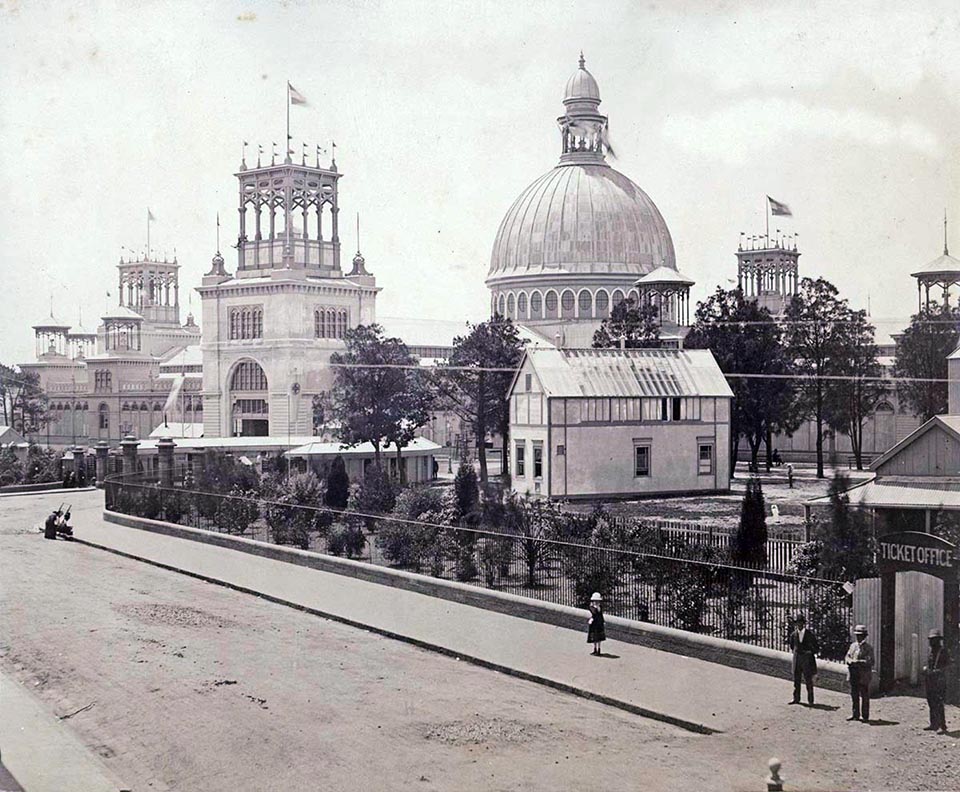
The Garden Palace, Sydney
Jonathan has reinterpreted one of Sydney’s great cultural losses which was the destruction of the vast Garden Palace in Sydney, which burned to the ground in 1882.
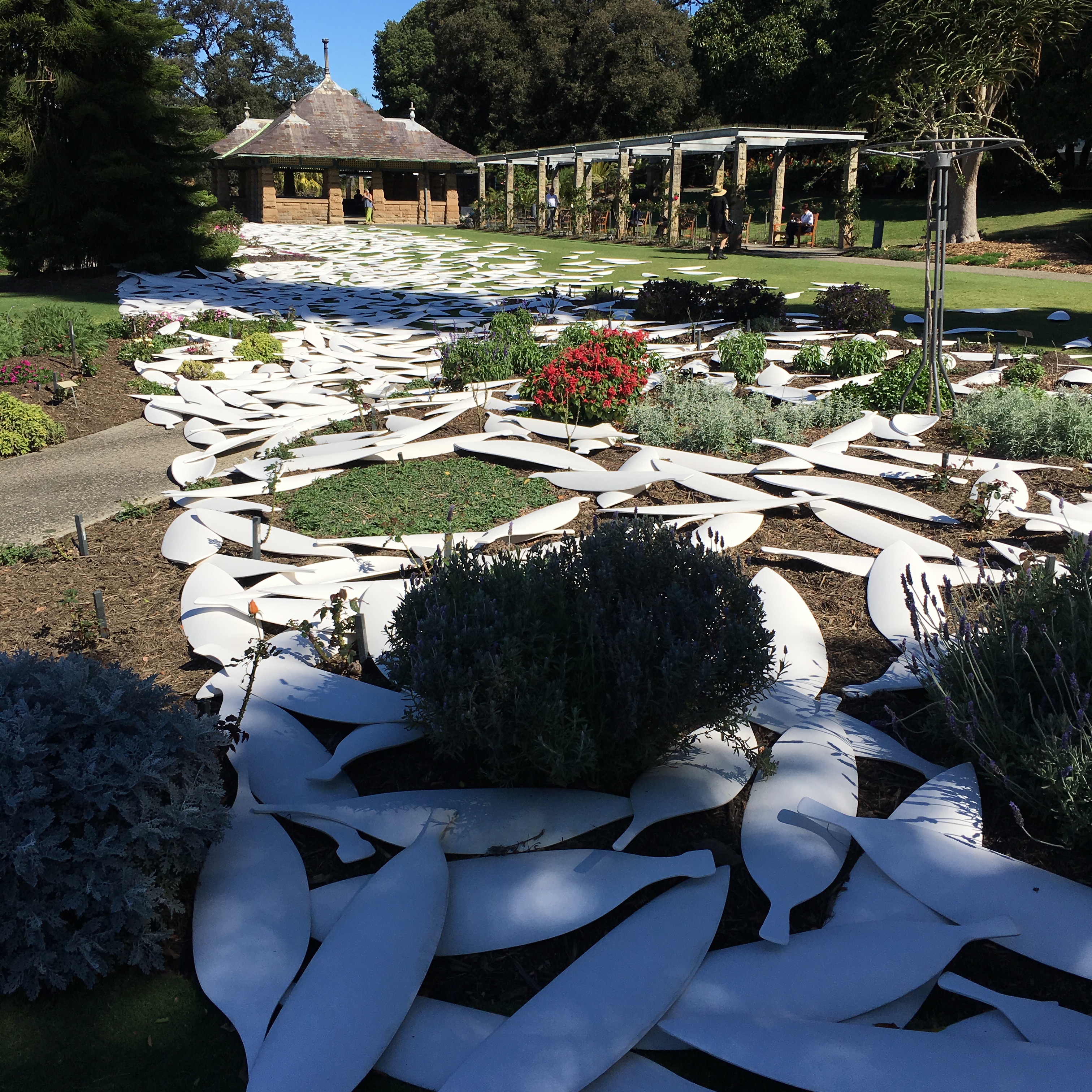
Bleached gypsum shields forming the border of what was The Garden Palace
The Palace contained many Indigenous Australian artefacts which were culturally significant and represented a link to country, part of the collective memory handed on from Elder to community and which can never be replaced. The loss was also greatly felt by the Colonials who lost many archival records, art works and museum objects (remembering that at this time there were no public museums or art galleries in Sydney, only in Melbourne). In a strange way there was some commonality of loss and understanding for all Australians arising from such a catastrophic event.
What stood out most about Jones’s interpretation was how the installation used physical elements like the kangaroo grass meadow and thousands of bleached gypsum shields to outline the original Garden Palace’s perimeter. The soundscapes of eight Indigenous languages drifted through the air, creating an atmosphere that transported the observer to another world. Daily conversations with historians, theorists, curators, artists, and writers as part of the public program encouraged the audience to reimagine the building, its history, and the cultural loss from both Indigenous Australian and Colonial perspectives. It truly made for a great conversation starter.
The arts have a powerful role in shining a light on social injustice and human rights issues, helping bridge the gap between Indigenous and non-Indigenous Australians by deepening our appreciation for the richness of Indigenous Australian culture. They highlight the importance of “connection to country” and the intricate ways unwritten knowledge is embedded in the natural environment. There’s so much we can learn, and it’s an opportunity that past generations failed to fully value.
One weekend, two heritage sites. Both The Dairy Precinct and the Yaralla Estate lie along the Parramatta River in Sydney, and I knew nothing about the history of either property before my weekend visit. Strangely there are some similarities in the way that both sites came into existence, but in 2016 there is little connection in the funding, management or the way each site is interpreted for the visitor, apart from the fact that both offer occasional guided tours.
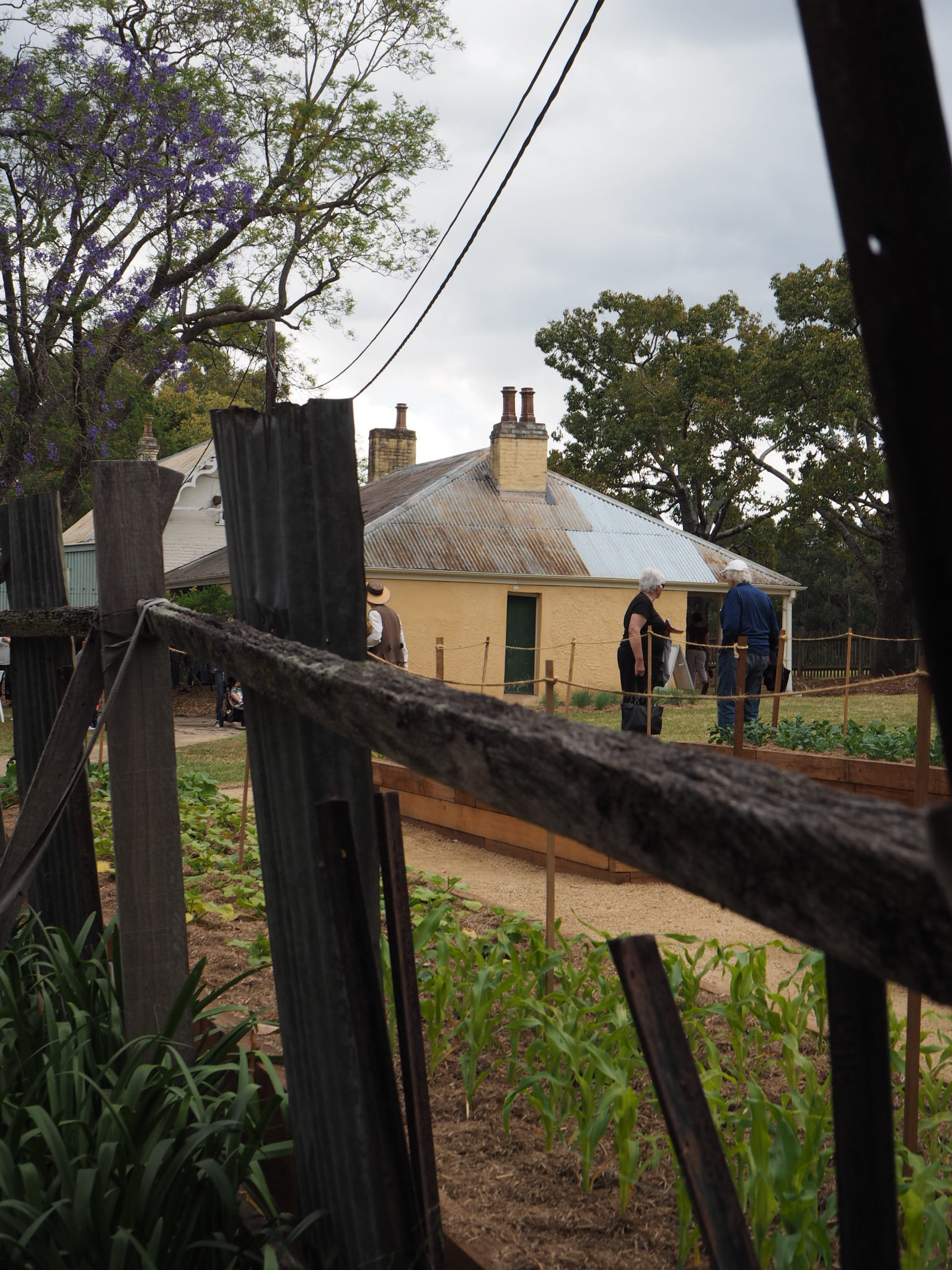
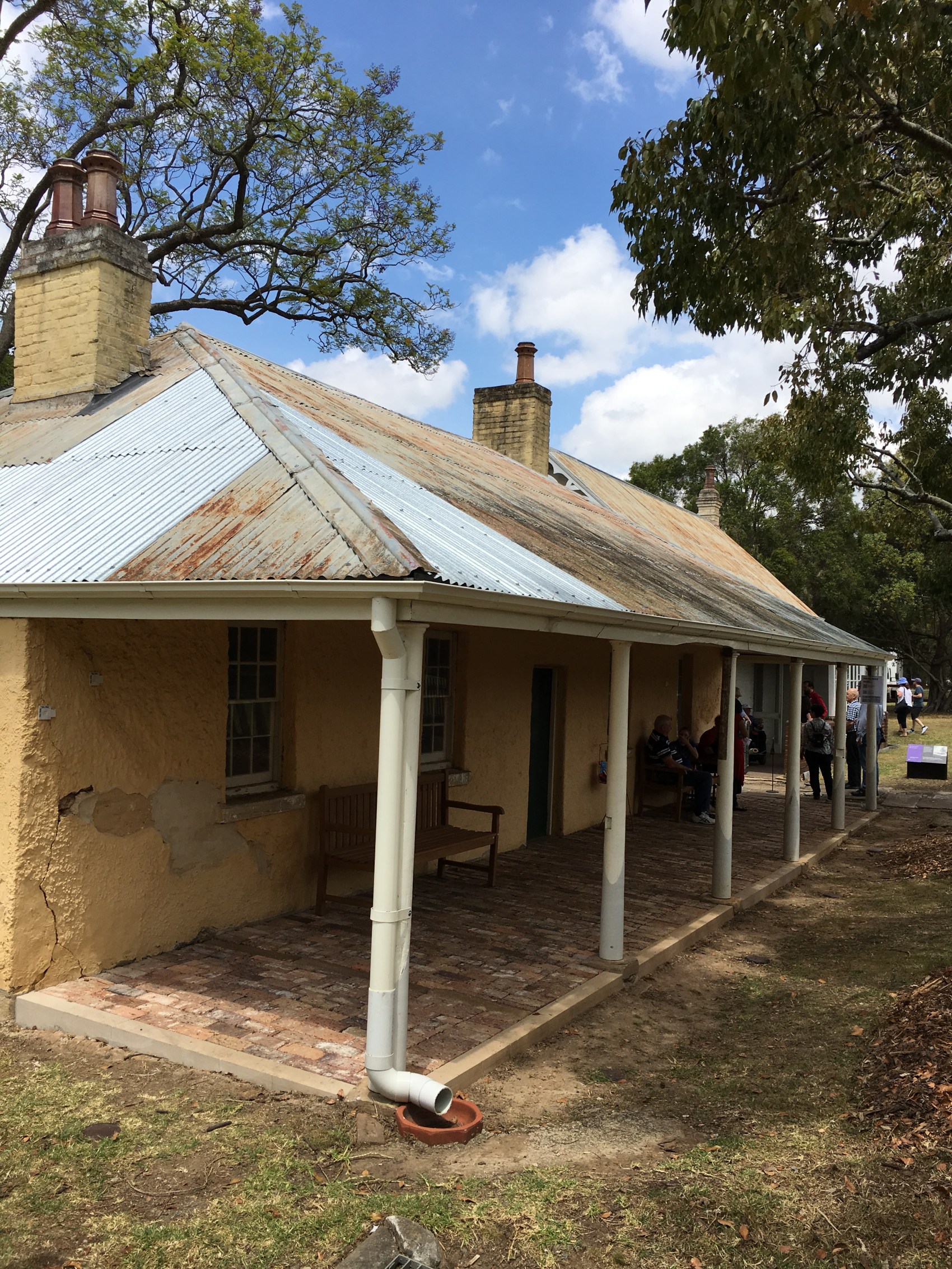
The Dairy Cottage was home to George Salter, an ex-convict turned cattleman who constructed the cottage in 1796, on his 30 acre grant. It was converted to a dairy after its purchase by Governor Macquarie c1813 to provide milk for Old Government House and the Female Factory. Macquarie added a sunken dairy processing room in an extension beside the cottage. A cow house and barn were also added to the original building.
The Dairy Cottage
The $1.7 million upgrade to the site has stabilised, conserved and enhanced the Dairy Precinct to improve the interpretation and understanding of the area as part of the greater Parramatta Park cultural landscape.
The new interpretation works really well for this small site and pays tribute to the Indigenous and Colonial Australian history of the site as well as orienting the visitor to the role that this site played in the early days of the colony in NSW.
During the recent “Day at the Dairy”, Parramatta Park Trust ran short half hour tours of the cottages. A longer tour option would be even more worthwhile because there is plenty to learn about the site. On the open day, the tour and the new interpretation were a perfect introduction to the site.
This slideshow requires JavaScript.
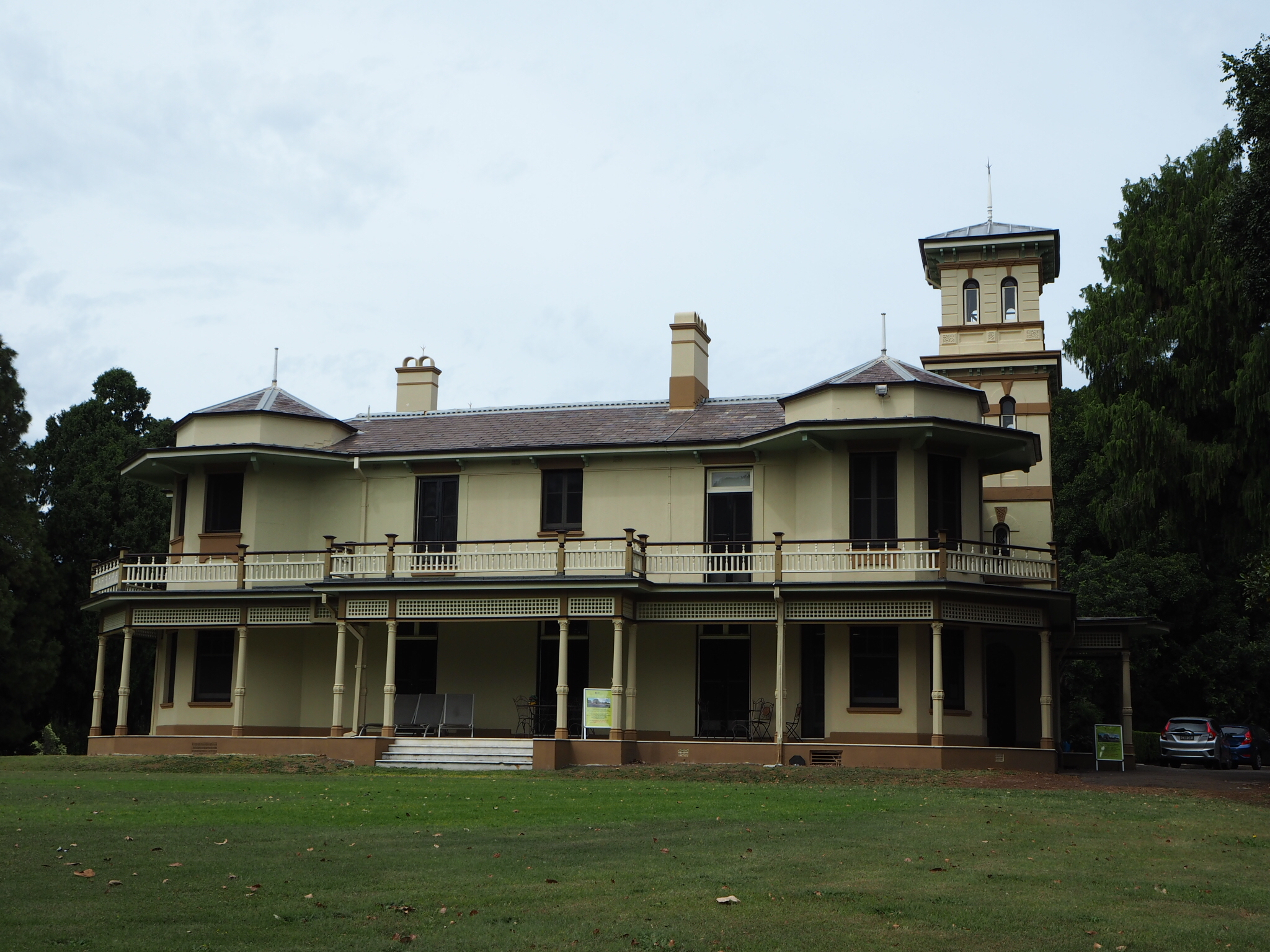
The second open day that I attended was at the Yaralla Estate, further down Parramatta River at Concord. Yaralla is of course much more than a dairy, but like the The Dairy Precinct at Parramatta, Yaralla began as a small land grant to a freed convict in 1797. Isaac Nichols not only grew food for the colony, but became Australia’s first postmaster.
The Walker family home at Yaralla
Eventually, debt ridden, Yaralla became part of the Walker family story until the death of Dame Eadith Walker in 1937. The property then became vested in the Crown under the Walker Trusts Act in 1938 and remains the largest community bequest of its kind to survive intact in NSW. The City of Canada Bay Heritage Society holds two major fundraising events at Yaralla each year and one at Rivendell, another property which is part of the estate, to raise funds for the continued restoration and to research the history of several outer buildings and gardens on the property.
This slideshow requires JavaScript.
Our guide Karina walked us through the estate armed with lots of narrative. We covered the original Nicholl’s cottage, the Dairy, the Coach house and Stables, the rose garden, the sunken garden, and then moved down to the river where the boathouse and wharf, swimming pool and grotto and the Powerhouse once stood. We then viewed the exterior of the Yaralla homestead (designed by Edmund Blackett and modified by John Sulman) rising above its Italianate terrace where there were originally croquet lawns and a tennis court. Our last stop was the Squash Court built for Prince Edward’s unofficial visit with Louis Mountbatten in 1920. The story goes that the court was never used because the floor was made of concrete rather than the timber flooring necessary in these types of courts. It is great that the volunteer guides know their history and are good storytellers since so much of the estate has already been destroyed in the name of progress or through vandalism and there is currently very little interpretation apart from some historic photographs and memorabilia on display in the Coach house and Squash court.
This slideshow requires JavaScript.
The Yaralla story is fascinating and the life of Dame Eadith would be a perfect plot for a movie. Born in 1861, Eadith lost her mother in 1870 and was raised by her aunt, Joanna, in a shared childhood with Annie Masefield (her companion and friend for life). She inherited Yaralla from her father, Thomas Walker, and made significant alterations to the estate. She was active in Sydney Rowing Club and the Animal Protection Society of NSW and was patron of the Yaralla Cricket Club and leased land to Royal Sydney and Concord Golf Clubs. She made a considerable contribution to several charities and to the Great War effort in both a physical and monetary sense. She was also very involved in supporting her own staff at Yaralla even after their retirement from the Estate. A woman well ahead of her time. The heritage society has produced a lot of information about the Walker family, and the history of the site itself. There are books and guides available through the Canada Bay Heritage Society website.
I guess my purpose for writing today’s blog was that I was struck by the similarities and contrasts between the two sites. The Dairy Precinct seems well managed and well funded by The Parramatta Park Trust while Yaralla needs more funding and support in the future. Yaralla does not enjoy the same profile in the community nor the funding that Parramatta Park receives.
Today, we are more connected than ever to our Australian Indigenous and Colonial heritage and Yaralla has suffered some significant losses through not having its significance acknowledged. NSW Health has done a great job restoring the old house (which is currently in use as a Dementia hospital) and the grounds are neat but there needs to be greater support to bring the Yaralla estate to the standard of Parramatta Park with its public recreation areas and heritage buildings. I couldn’t help thinking how great Yaralla estate would be as a public park in the ever increasing concrete jungle springing up around Parramatta and along the river bank.
Over time, Australia’s amazing indigenous, maritime and cultural heritage is being uncovered via numerous archaeological investigations, many of which pre-date The Heritage Act 1977. I was amazed when I visited an Open Day in Parramatta for the Centenary Square development to see the incredible history which lay under the Post Office and surrounds in Macquarie Street. Strangely, although this site had been built on in the interim, there was a large amount of archaeological evidence still visible from the earliest times such as the footings of pre-existing colonial buildings and a variety of everyday objects uncovered by Casey and Lowe’s meticulous dig. I wondered whether we had lost the context for the earliest land use of the site because it had already been disturbed? I guess that the most recent dig will be the last opportunity to research Parramatta’s past from the Centenary Square site because once the underground car park has been excavated – the existing layers of history in the substrate will be lost.
This slideshow requires JavaScript.
That isn’t really why I was writing the blog post. The point I was actually thinking about after my Centenary Square visit was that if we continue to subdivide Parramatta and other parts of urban Australia into tiny blocks (which seems inevitable), then what happens to the layers underneath? If the colonial subdivisions are double, triple or quadruple the size of the modern land holdings, what will happen to the archaeological material and the context of where that material is located below the surface? The size of indigenous Australian history layer will be even greater. If an archaeological survey is required by a developer before an underground car park is excavated, are we only getting part of the story from the archaeological report? Are we looking at half a house, quarter of a hotel or a miniscule portion of a larger landholding such as market gardens, farm, factory or place of indigenous significance? Considering that the layers of earth below the surface can reveal so much about our past and that suburbs like Parramatta are a significant part of the history of Australia, I really hope that some very important person with vision or the Office of Heritage and Environment or local council responsible has all this in hand before the evidence and context is destroyed for all time.
P.S. After I posted this I noticed some posts by @gmlheritage on Instagram showing items from the archaeological dig of 200 George Street, Sydney, reinterpreted for use in the foyer of Mirvac’s new headquarters. Great to see the objects used along with some explanatory text about the site’s history supported by a wonderful artwork by Judy Watson on display in the public foyer instead of being archived in boxes and stored out of sight.
Government funding cuts affect all Australian museums. Museums are always looking for a point of difference – to produce newer and more engaging exhibitions to claim a larger share of the tourism/leisure sector dollar. They aim to increase their revenue by growing visitor numbers, partnering with corporates and attracting new sponsors to work with them into the future.
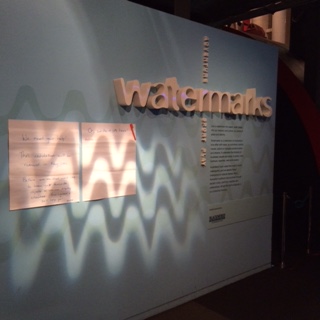
Entry to the Watermarks Gallery
When a permanent gallery is no longer seen as an attractive option for visitors, it is important to reflect on why it may have lost its pulling power with audiences before we throw the baby out with the bathwater. A case study for discussion is the Watermarks gallery at the Australian National Maritime Museum which will be replaced by a new permanent exhibition in late 2016 / 2017.
A study of the Watermarks gallery looked at the visitor response to both the objects on display within the space and the layout of the gallery. Museum visitors were observed over two weeks during school holidays which resulted in several findings about the space.
Firstly, 17 guided educational tours had been developed by the Learning and Education team in Watermarks for school groups. Each tour was designed to address criteria outlined in the Australian National Curriculum Guidelines (for Kindergarten – Year 12), looking at – waterways and the environment, Australian colonial history, Australian history in general,
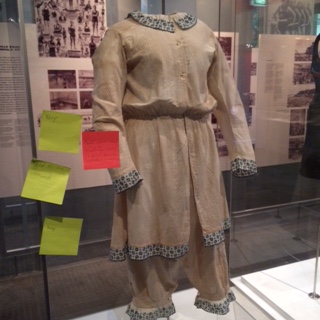
Post-it note experiment in Watermarks Gallery
maritime archaeology, navigation, identity, transport, swimwear and textiles. The objects within the space offered good sensory, emotional and educational possibilities to connect with the past but without the guided educational tour, their significance seemed lost in the flow and layout of the existing gallery which left self-guided visitors disengaged. A simple experiment was conducted with Post-It notes. Visitors were asked to tag their favourite objects and write on butcher’s paper about the thematic areas that they felt should remain on display and intact within the museum (or possibly in a travelling exhibition for other museums/galleries). As a result, visitors spent longer in Watermarks, engaged more with all of the objects and voted strongly for certain objects and sections which should be kept on display.
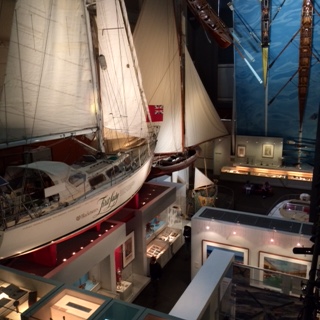
Gallery from above
Secondly, there were four entry and exit points to the exhibition which resulted in many visitors not understanding the original inspiration for the gallery which was “Australia’s ongoing relationship with water” viewed through the themes of Swimming, Rowing, Regattas, Sailing, Surfing and Indigenous Australia. In a gallery with so many entry and exit points, I observed that three simple solutions could have been applied to help restore the intended narrative:
reduce the number of pathways through the space
label every entry point with a text panel which reflects the inspiration for the area and its relevance for the gallery
ensure that each themed area has a narrative of its own which can stand alone and yet remain connected to the original Watermarks interpretation.
Thirdly, it was noted that the digital components of the gallery had great content but were not necessarily in optimum positions within the space to show off that content. For audiences to successfully engage with the digital components of any exhibition or permanent gallery, it is critical that:
Audio Visual (AV) stations and touch screens are working correctly
AV stations are well positioned
For substantial content, e.g. films lasting several minutes, that seating is available for the viewer
Text panels supporting the AV stations provide sufficient explanation on the way that the station should be used. For example, films may be self-explanatory whereas other interactive stations may require a little more context for their optimal use.
Finally, museums and department stores have traditionally had comparisons drawn when it comes to aesthetics and audience engagement. Perhaps museums could learn from the mistakes of the department stores in the current economic climate. It may be that cutting floor staff numbers will not necessarily increase profits. My observations in Watermarks have only strengthened my opinion that many visitors like to see the presence of facilitators, invigilators, educators, security or guides in the gallery or exhibition space. I have observed that visitors:
stop to ask questions or for directions or assistance
might ask for extra information about a display or gallery
might have their own narrative to share triggered by seeing an object in the space
may have feedback for the museum about their visit.
It seems a pity when the audience is captive in the space, not to utilise that opportunity for engagement and feedback and to build relationships with the public, particularly when museums and galleries are striving to be “must see” destinations. In short, even if a gallery appears to have lost its pulling power, it may still have one last lesson to give museum staff before its removal.
I do think that there is a place for audio tours in galleries and museums. I occasionally like to take a guided tour with a gallery staff, volunteers or an audio tour, particularly when I am unfamiliar with the subject matter of an exhibition or when I am in a different country and English is not one of the primary languages spoken in the museum.
An audio tour can really enhance the visitor experience and was probably at the forefront of museums trying to better engage digitally with their visitors. The first audio tour is said to have been developed by the innovative Director, Willem Sandburg at the Stedelijk Museum, Amsterdam as early as 1952, and there have been many changes and improvements to audio technology since then.
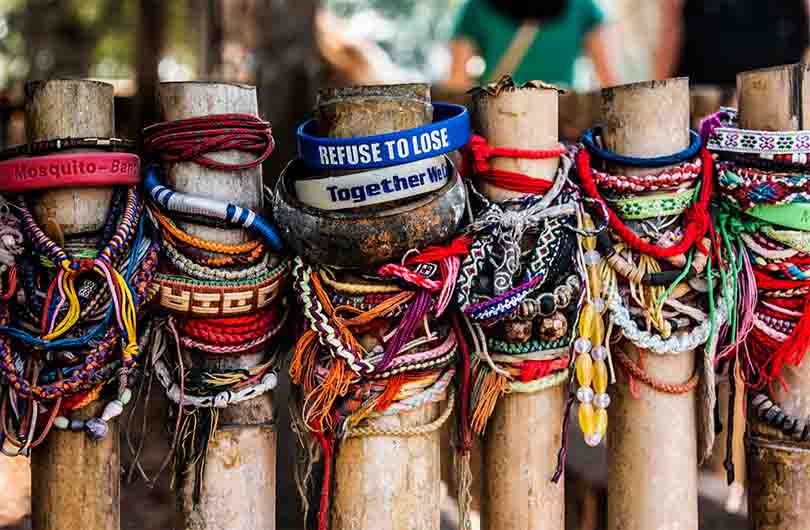
The best audio tour that I have ever taken was at Choeung Ek (the Killing Fields) in Cambodia. The tour was developed by an Australian company – Narrowcasters (available in 15 languages) and allowed the visitor to move around the memorial park at their own pace, to stop, sit or reflect on the horrific events surrounding the genocide of three million Cambodians by the Khmer Rouge. The audio used historical facts, music, poetry and the personal stories of survivors which were incredibly evocative and dealt with difficult subject matter in a place which was full of the ghosts of innocent men, women and children. The park had plenty of space for visitors to wander in peace and quiet to think their own thoughts in relative silence.
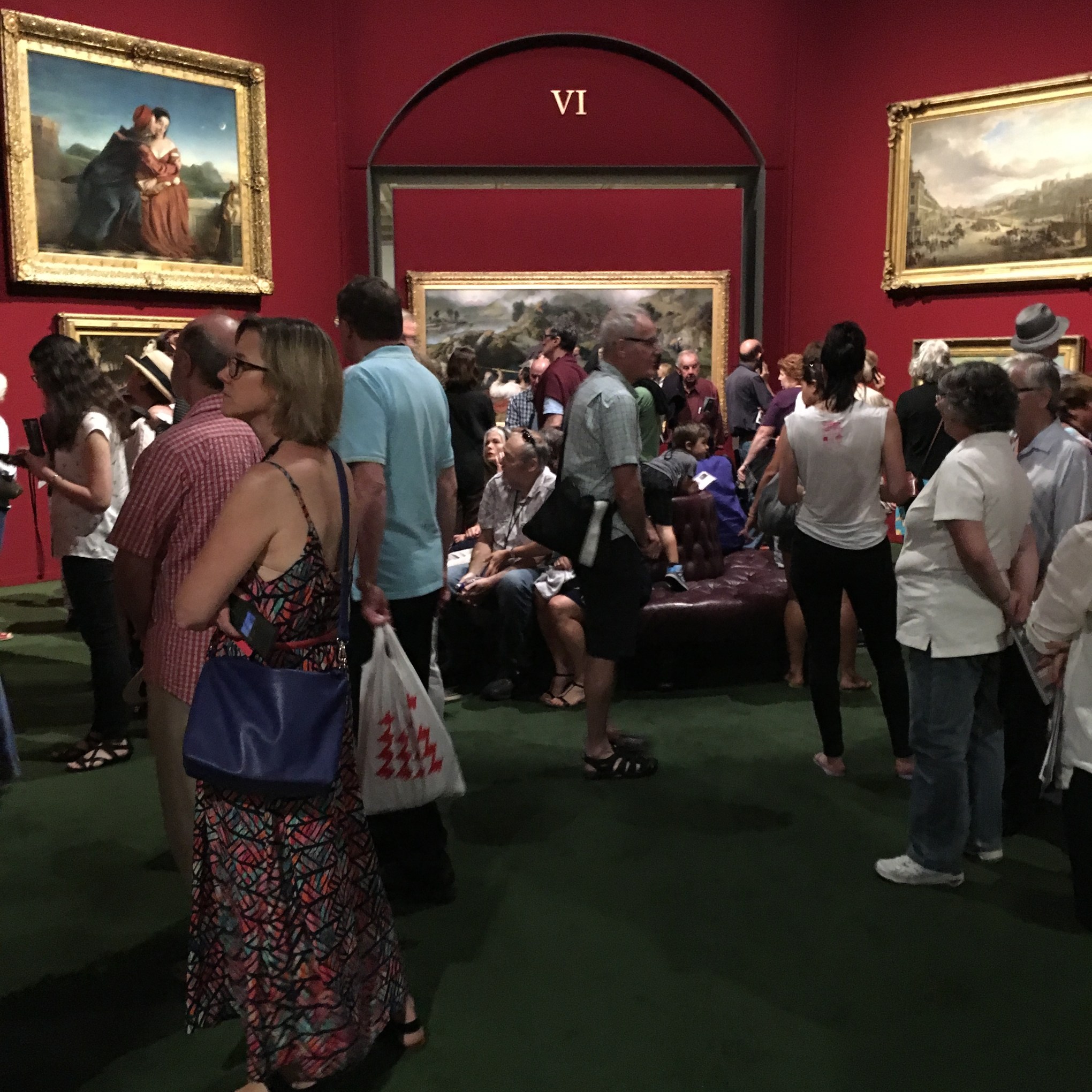
Scottish Greats at AGNSW
Sadly, when I visited the Scottish Greats at the Art Gallery of NSW , the free audio tours detracted from my museum visit because the majority of visitors forgot about their audio tour etiquette in the limited exhibition space. I decided not to take a tour on this occasion because I wanted to really look at the objects, drink in the fact that I was actually seeing some of them in real life and then go back and look at the information about the works that I was drawn to.
I learned this technique from Heather Whitely Robertson who was at the Museum of Contemporary Art, Sydney (Director, Audiences and Creative Learning) and has now gone to the Art Gallery of NSW, Sydney (Head of Activation and Learning) in a similar role. It works for me because I am a visual learner and I like to connect with objects visually in the first place and then find out the facts later. At the MCA, Heather and her team introduced all sorts of techniques to encourage students to engage with exhibitions in a more creative way rather than just ticking off the visit and walking away with very little learnt from the experience. As far as taking audio tours, users need to follow some basic rules.
Rule No 1 for Audio Tours
Look at the object in front of you and then step back to listen to the information being provided on your audio guide. Do not stop and stand in front of each object for an inordinate amount of time, blocking the view of crowds milling around behind you while you remain oblivious to their presence and mounting frustration.
Rule No 2 for Audio Tours
Do not have conversations with your companions when taking an audio tour because you have something in your ears and you don’t realise that you are talking loudly which spoils the atmosphere for the rest of us trying to soak up the beauty of the amazing works from the Scottish National Gallery in Edinburgh (or any other gallery or museum!).
There may be other rules that I haven’t thought of yet.
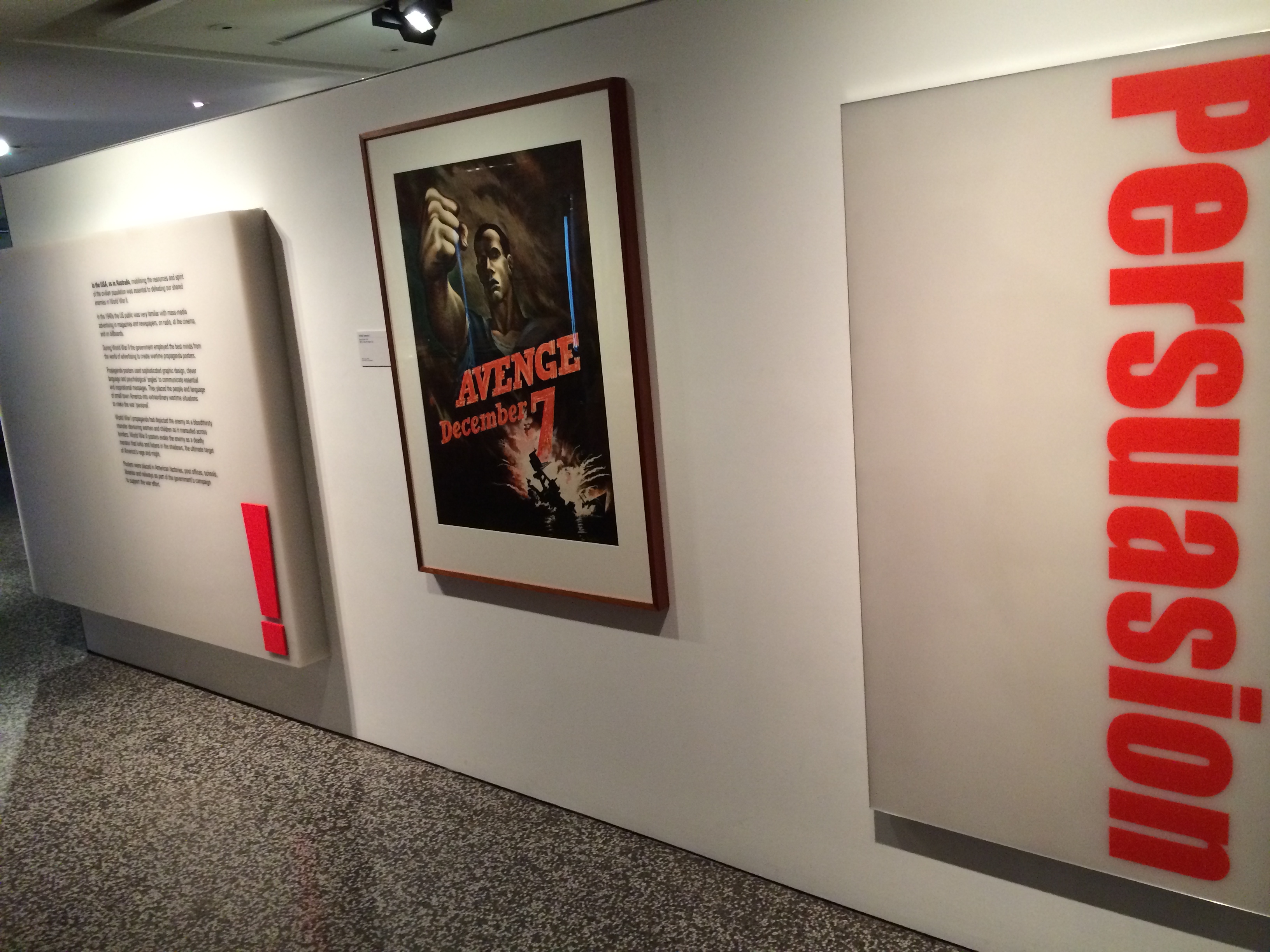
Persuasion – an exhibition of wartime propaganda art at the Australian National Maritime Museum
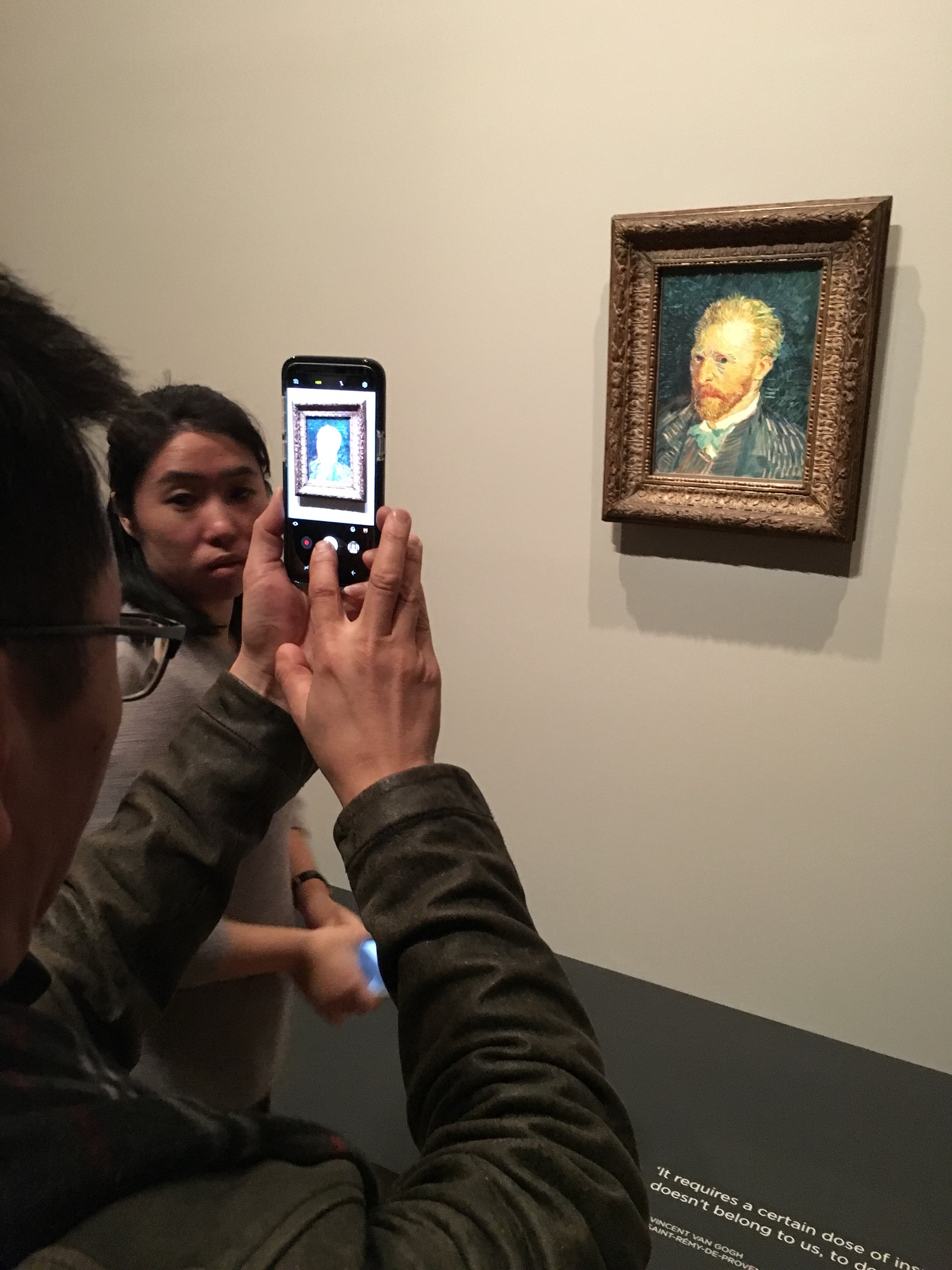
Many museums and authoritative museologists have written guides or chapters in their books on producing text and labels (see VandA guidelines for example). As a Masters student visiting the Museum of Contemporary Art in Sydney, I was given some good advice by art educator about looking at and learning from objects in a more creative way than just using text and labels. Now I have changed my approach to my own museum and gallery visits. I always focus on the objects first, and if they interest me, I read the text and labels. It’s like reading the book rather than seeing the movie. When you actually look at an object, you can use your own imagination to make a decision on how connected you feel (if at all) to that object and what you see is not a predetermined response to the information given in the text panel or label (or audio tour for that matter).
I like to find out information about the objects that I connect with – their age, construction method, maker, provenance and the story behind their creation so I use the text panels or the internet for extra information about various artists or particular objects. For example, after seeing prints by Koizumi Kishio and Onchi Koshiro, I found that I had strong connection to the type of Japanese woodblock prints created by these Sosaku Hanga artists who are not as well regarded as Ukiyo-e printmakers like Utamaro and Hiroshige. I love the fact that these “creatives” were involved in the process from start to finish and that they don’t use other artisans to design, carve and print their wood blocks. Their works on the surface don’t appear as complex and yet these artisans were highly skilled individuals. In another exhibition at the Museum of Contemporary Art in Sydney, I learned about the animated installations by contemporary Japanese artist Tabaimo who creates thousands of detailed drawings which are laboriously scanned into her computer to create her wonderful works. These facts gleaned from text panels and further investigated on the internet added value to what I saw on display and my appreciation of the works that I initially connected to.
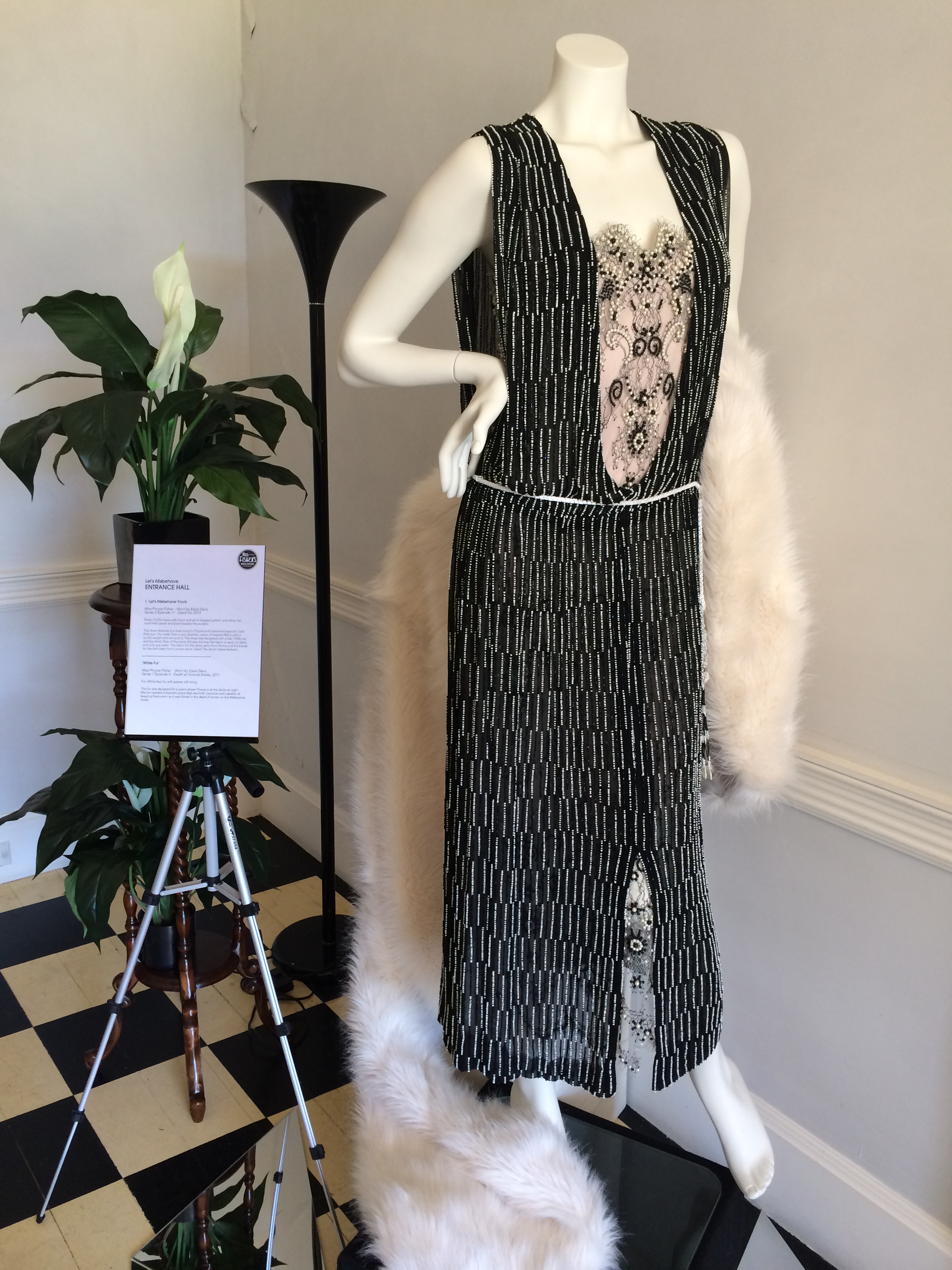
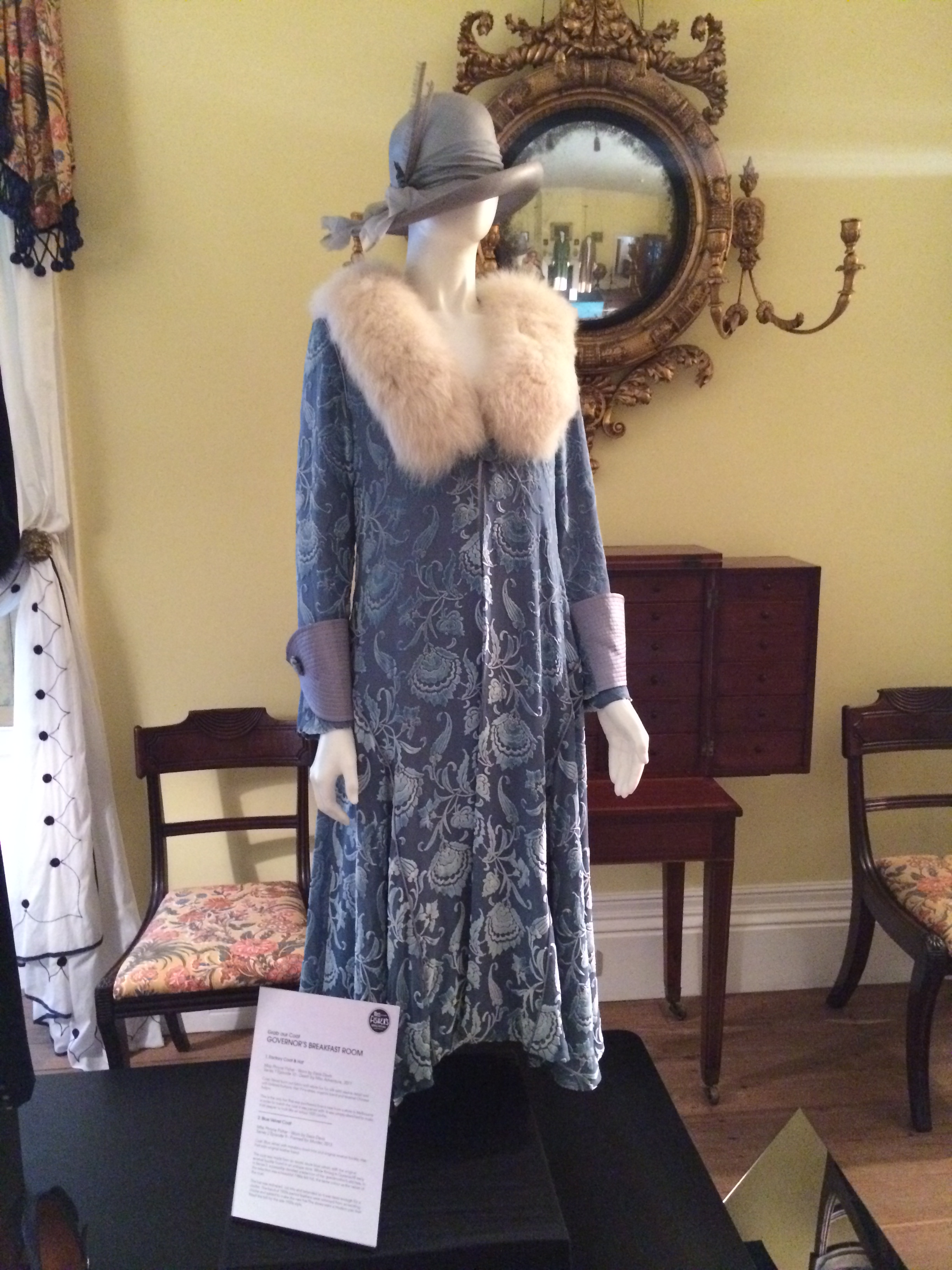
Text panels of different heights at Old Government House, Parramatta for Miss Fisher’s Murder Mysteries Costume Exhibition in 2014.
One instance of the text being too low for visitors to access easily. This problem has been corrected in the new 2016 exhibition.
Although officially the importance of text and labels has been recognised, theorised and documented, I still notice that many art galleries and museums are not getting it right.
When you track visitors in any gallery space, it is surprising how their behaviours can vary. Very few will stop and read all the labels and even fewer will read the labels in any kind of order and so it is important to grab their attention when you have a chance. Yes, labels must be accessible for wheelchairs and children but what about those with poor sight or the elderly who can’t bend down too far. Labels need to be in bold print and text must stand out from the background even if the lighting in the room needs to be dimmed for conservation reasons. I have seen elderly people nearly fall over while bending to see a poorly placed label. I have seen others struggle with text on an inappropriate background colour which makes it difficult to make out the words. I have seen visitors wasting time trying to find out information about an object when a label is missing or incorrect. Labels need to be visible to several viewers at the same time and able to be viewed from a distance. They should not be too detailed because their role is to enhance the experience of seeing the object rather than take over from the object.
The British Museum speaks about the use of “Gateway Objects” to catch the eye of the viewer with accompanying text to allow the visitor some understanding of the space and themes of the gallery without having to read every single label in the exhibition. These objects aim to engage the audience quickly with enough information on the label to draw them into the exhibition or gallery. I guess that my newly adopted technique is similar, but without well written labels may not always be as good as the constructed British Museum experience. Thinking about the short window of time to grab the audience’s attention – 30 seconds or so – and realising that the average visitor may spend less than 10 minutes in an exhibition……. museums really need to think about the importance of well designed and well written text and labels to accompany the objects on display.
See also:
Australian Museum – Writing Text and Labels which also discusses the audience response to text and labels.
Ai Weiwei using Lego to draw attention to issues of social justice.
Entry to Ai Wei Wewi’s Lego installation at NGV
Inside the Lego installation – studying the comments made by various activisits in Australia.
Don’t get me wrong – I love Lego. It is a wonderful creative tool with endless possibilities but I am so sick of seeing it in museums and galleries as the main attraction.
Audience engagement is something that I’m passionate about. I don’t think that the museum sector can just sit back and wait for visitors to come through their doors because of a single exhibition or a Lego attraction. They need to build on relationships with their local communities and develop a substantial membership base, offering reasons for members to visit frequently. They need to be creative and flexible with their collections, providing a great package for tourists who may only physically visit the museum once in their lifetime and also for the “not so local” visitor to give them a “taste” of what’s on offer. Realistically, a “taste” (and an entry price) which makes the visitor want to return to the museum the next time that they’re in town.
I don’t begrudge National Galleries Victoria (NGV) for harnessing Ai Weiwei’s talent to create a major new installation using Lego for the recent NGV Andy Warhol | Ai Weiwei blockbuster exhibition (December 2015 April 2016). Weiwei’s crowd-sourced Lego work focused on Australian activists, advocates and champions of human rights, freedom of expression, freedom of information and the internet and highlighted many of the current social justice issues facing all Australians. But seriously, everyone else needs to give Lego a miss for a while and work harder to attract visitors, particularly families, with innovative exhibitions and galleries using their own unique collections or borrowed works from other places which are in line with the stated vision and purpose of their space.










 Museum Whisperings