


During a trip to the Flinders Ranges in South Australia, I saw fossils that were evidence of the earliest forms of life on Earth and admired incredible Indigenous rock art. Exploring such an ancient landscape, with its natural beauty and deep sense of spirituality, inspires a deeper appreciation for the rich culture of our First Australians.


I’m slowly beginning to grasp the deep connection Indigenous Australian people have to the land after spending time in places like the Flinders Ranges and Mungo National Park, and by listening to local Park Rangers as well as interviews like 702 ABC Radio’s Conversations with Richard Vidler. Richard interviewed Lynne Kelly about her book “The Memory Code” in 2017. Lynne has explored traditional Indigenous Australian songlines as a key to memory, revealing layers of information embedded in the Australian landscape. These songlines are passed down through stories, songs, and traditional dance.
The strong unwritten and oral history of Aboriginal Australians is passed down by Elders within the community. So much of this knowledge is key to survival. Knowledge about the landscape, navigation, ancestral totems, food and medicine, trade routes, culture, law and history. Information is shared through stories, traditional dance and song. Kelly speaks about the way that non-written memory systems are coded into the natural and built environment. She believes that this system was not only used in Australia but may have been used by other ancient cultures around the world.
Learning how Songlines work has changed my perspective on the harm caused by disconnecting Indigenous Australians from their land. The impact must have been devastating, causing deep pain through the loss of culture and vital survival knowledge. While Australians can relate to the struggles of displaced peoples around the world, the situation here is even more complex. I’m not suggesting colonial Australians did this intentionally, but the outcome remains the same—and it’s profoundly significant for our Indigenous communities. I had these new thoughts on board when I attended the Royal Botanic Gardens in Sydney to see Jonathan Jones’s exhibition, “Barrangal Dyara (Skin and Bones)” which was Kaldor Public Arts Project no.32.
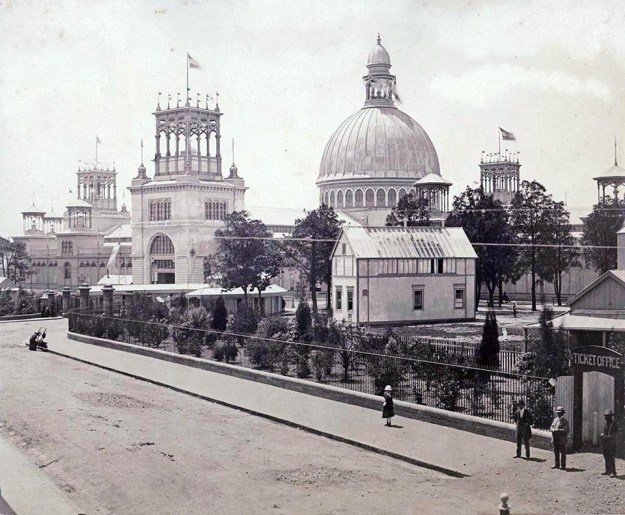
The Garden Palace, Sydney
Jonathan has reinterpreted one of Sydney’s great cultural losses which was the destruction of the vast Garden Palace in Sydney, which burned to the ground in 1882.
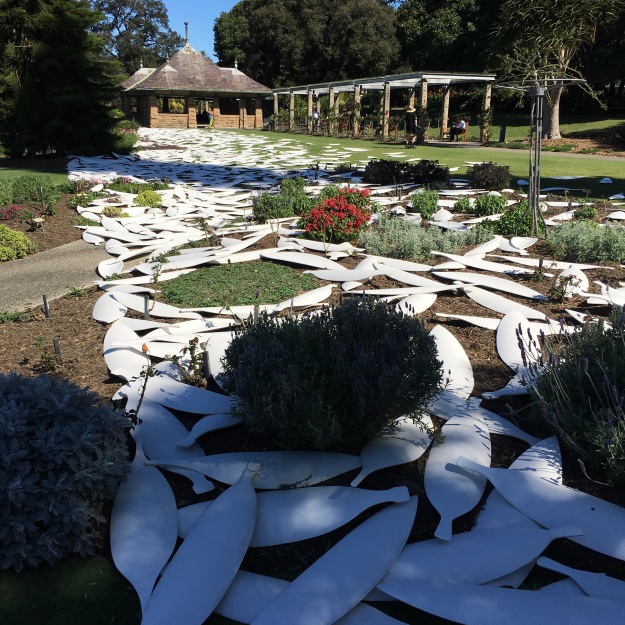
Bleached gypsum shields forming the border of what was The Garden Palace
The Palace contained many Indigenous Australian artefacts which were culturally significant and represented a link to country, part of the collective memory handed on from Elder to community and which can never be replaced. The loss was also greatly felt by the Colonials who lost many archival records, art works and museum objects (remembering that at this time there were no public museums or art galleries in Sydney, only in Melbourne). In a strange way there was some commonality of loss and understanding for all Australians arising from such a catastrophic event.
What stood out most about Jones’s interpretation was how the installation used physical elements like the kangaroo grass meadow and thousands of bleached gypsum shields to outline the original Garden Palace’s perimeter. The soundscapes of eight Indigenous languages drifted through the air, creating an atmosphere that transported the observer to another world. Daily conversations with historians, theorists, curators, artists, and writers as part of the public program encouraged the audience to reimagine the building, its history, and the cultural loss from both Indigenous Australian and Colonial perspectives. It truly made for a great conversation starter.
The arts have a powerful role in shining a light on social injustice and human rights issues, helping bridge the gap between Indigenous and non-Indigenous Australians by deepening our appreciation for the richness of Indigenous Australian culture. They highlight the importance of “connection to country” and the intricate ways unwritten knowledge is embedded in the natural environment. There’s so much we can learn, and it’s an opportunity that past generations failed to fully value.
 Museum Whisperings